Post Camino Day 2: Still just chilling out

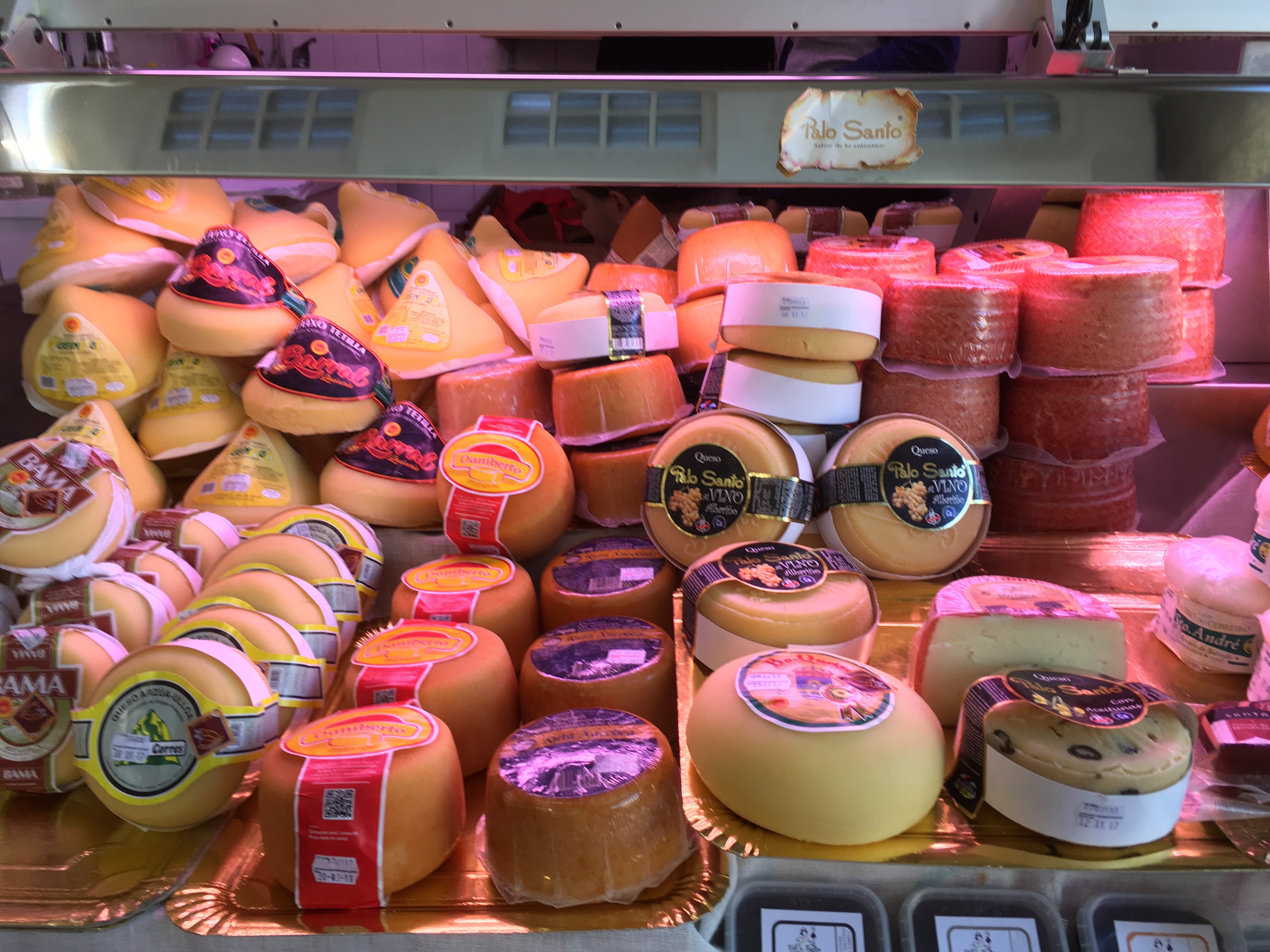
Today was a chilling out day – slept in until 7:30 am, relaxed breakfast, and wandering around Santiago. We visited the market and did some shopping. 

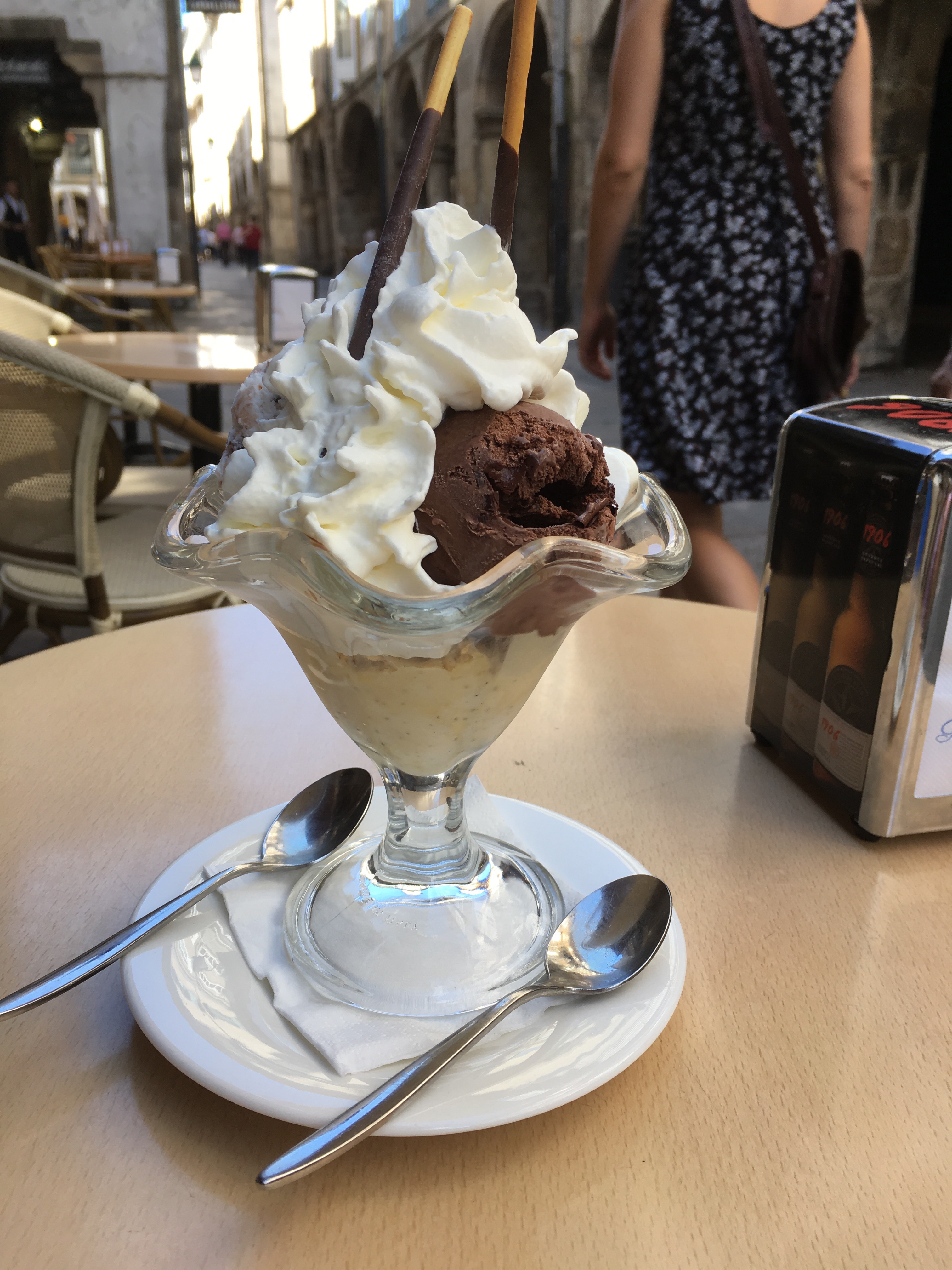
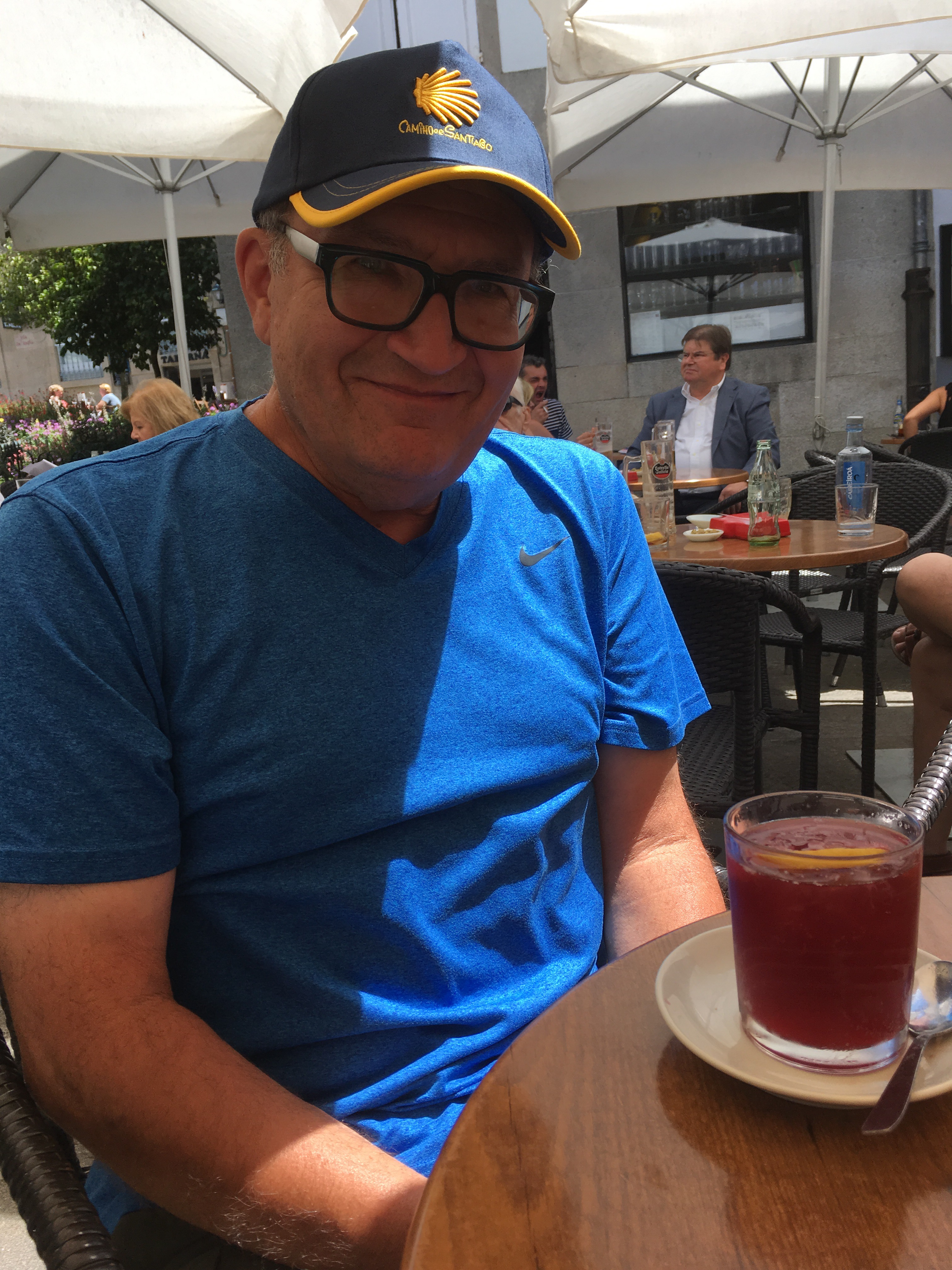
There were a few things we had not yet sampled – helado (ice cream) and sangria were on the list.


We did some shopping – a few small mementos for our kids and ourselves, and took a short afternoon siesta.

I had scheduled a wine and tapas tour through a company called Devour Galicia. We were the only people on the tour so we didn’t get the social aspect. It focused on some Galician specialties. It was OK but it did not hold a candle to our tapas tour in Madrid. And to be frank, we had already sampled all the foods and wines before!

Tomorrow we are going to Finisterre and Muxia, the furthest west points in Spain and the 0 km point on the Camino. Then the next day (Thursday, July 13) we are heading home. After we return home, I will be posting post-Camino thoughts/impressions. 

Post-Camino Day 1: Santiago R&R day

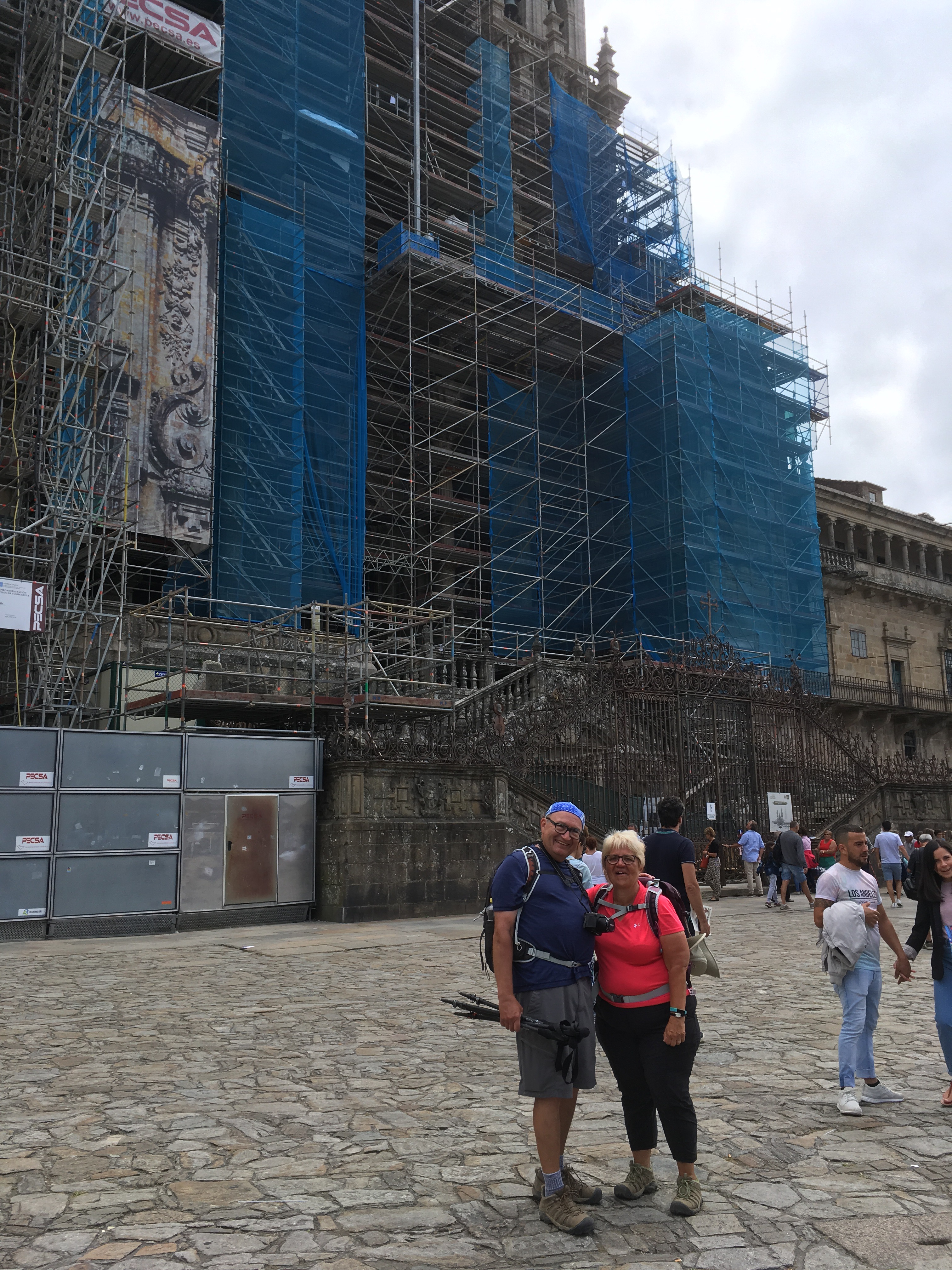
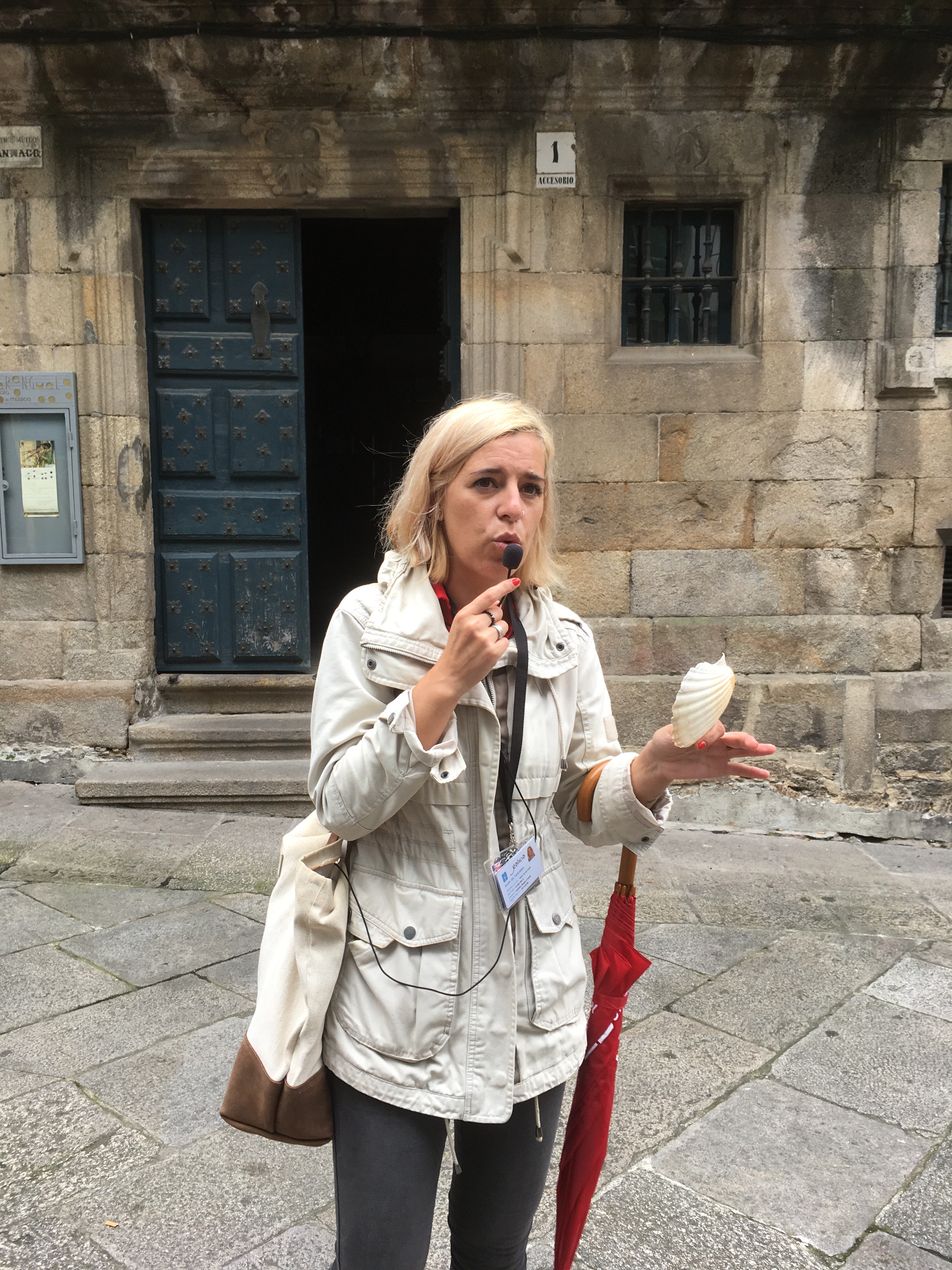
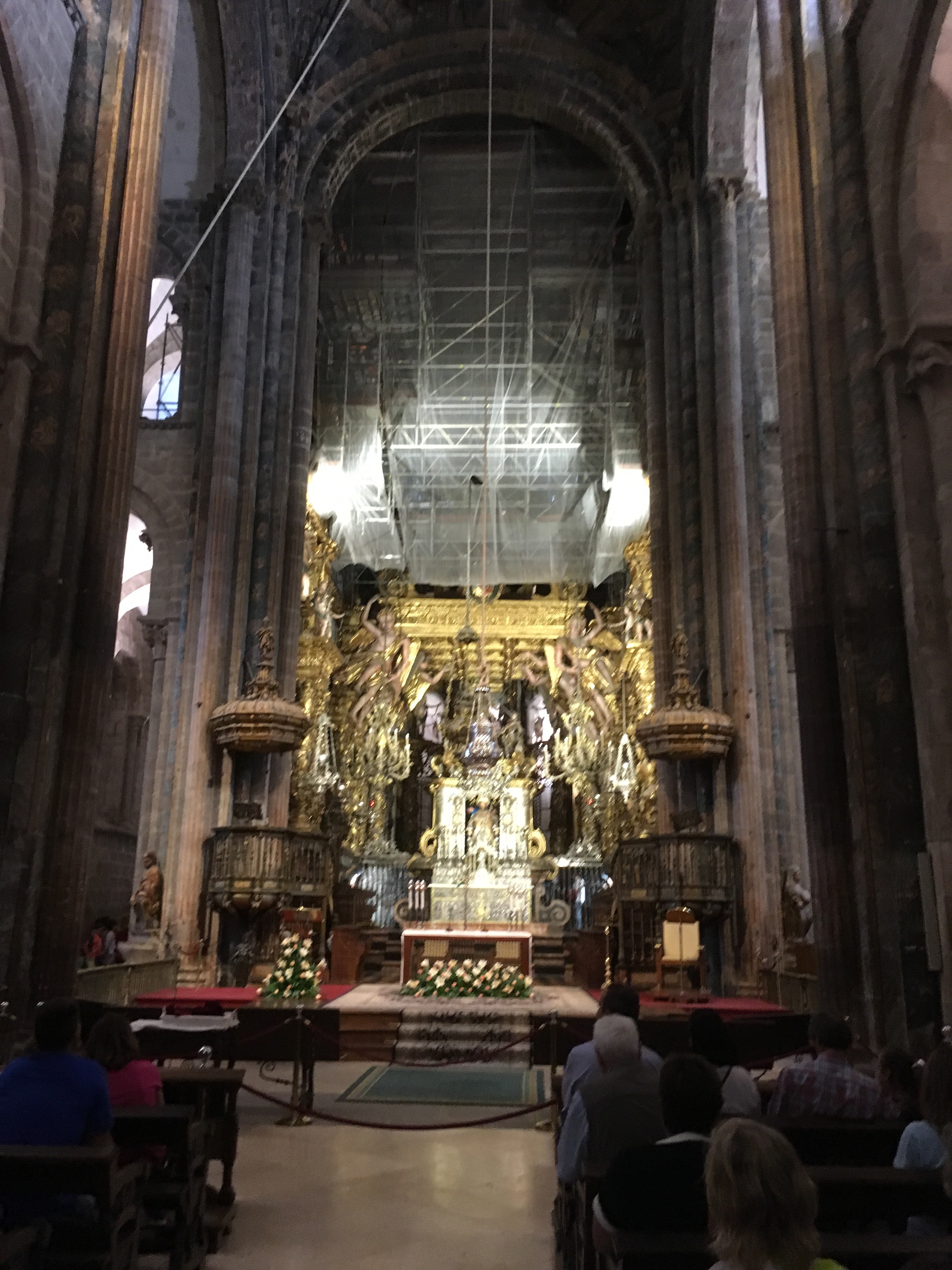
It was really weird this morning! We had a leisurely breakfast in our very charming hotel and we did NOT have to walk 15 miles of the Camino. So what did we do instead? We took a walking tour (actually two) of Santiago. We started with Paula of Compostela Free Tours (“look for the red umbrella”) who led our group of approximately 15 random tourists on a historical walking tour of the old city. We learned about the rich history of both the cathedral and the city. The original church was built in the 9th century over the supposed remains of St. James, the Apostle, but it was destroyed by the Moors and the present cathedral was started in the 11th century. It is a melange of architectural styles ranging from Romanesque to Gothic to Baroque. The exterior is covered by scaffolding (since 2005) as the facade undergoes restoration which is supposed to be complete at the end of 2018 (but more realistically in 2021 for the next Holy Year).

(That’s us the day we arrived.)

We strolled around the city and our guide entertained us with interesting anecdotes and explained about the three main symbols of Santiago: the shell, the star, and the tree. They are omnipresent in the old city and designate which organization owns the building; the government, Catholic Church of the monastery (which ironically always tried to upstage the Church). 

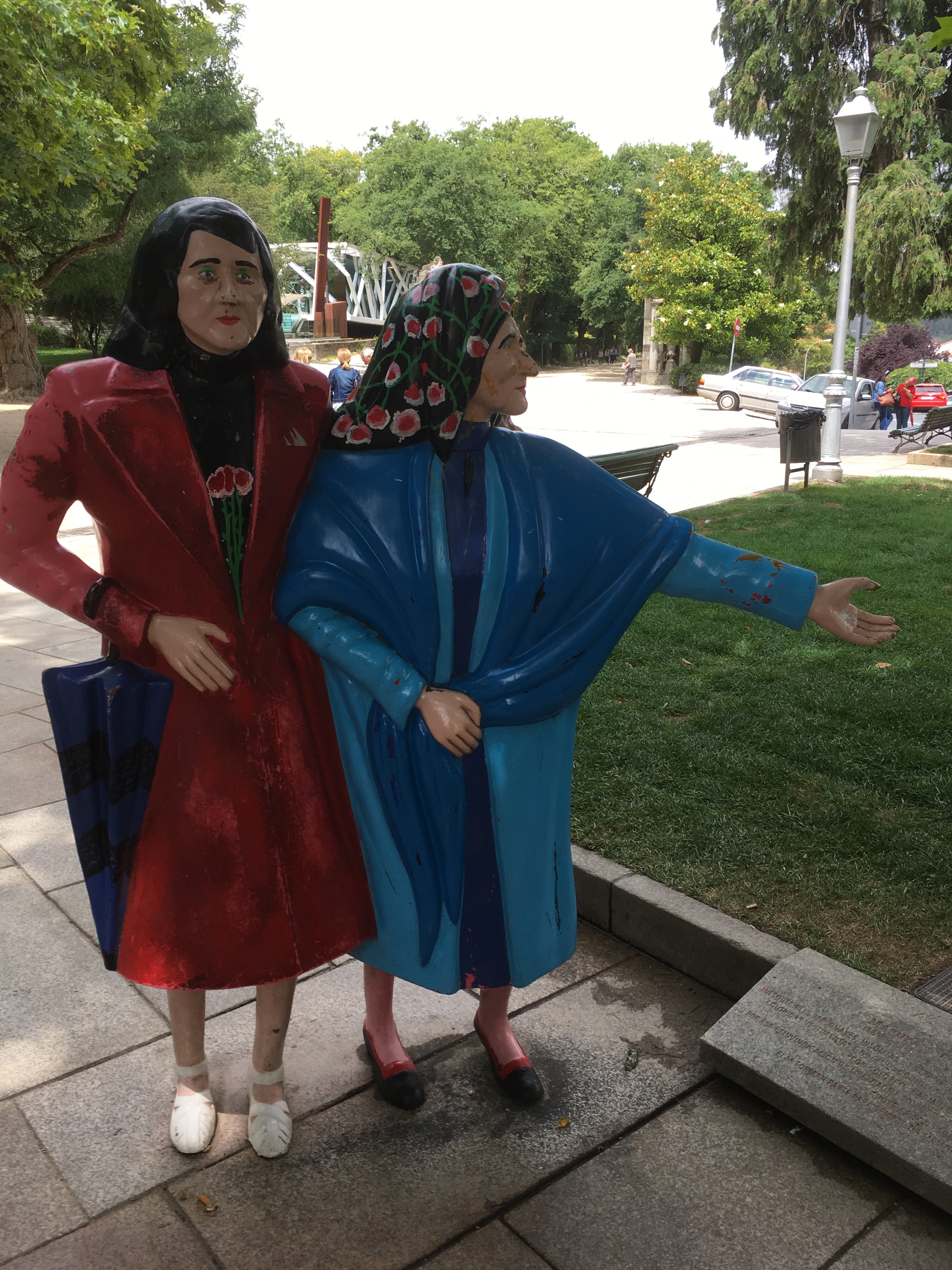
We ended in Alameda Park at the edge of the old city and learned the history of the two Marias – two sisters (Maruxa and Coralua Fanino Ricarr) from a family of 13 siblings, whose family played an active role in the struggle against the Franco regime. The family was consistently interrogated and tortured and it was rumored that these two sisters were raped. Although trained as seamstresses, they were unable to find work. The locals donated food and other items so they could survive. When their home was damaged by lightening, enough money was collected to build them a new house. They were infamous for going out every afternoon to Alameda Park, at the edge of the University, dressed in bright colors (not acceptable during the Franco regime) and with full make-up to flirt with the much younger university students. Some thought that these women were mentally unstable while others thought they were just trying to get enjoyment from their tortured existence. They died in the 1980s and a statue was erected in 1993 celebrating these women who many felt were symbols of the fight against oppression. 


We then returned to our hotel for a second walking tour, focusing on the   Cathedral. It was led by Margarina, a local guide, who gave us a lively and amusing insight into the history of the city as well as the Cathedral. She explained the various architectural styles, and she recounted a few instances when the botafumeiro ( large incense burner used to cover up the foul odor of the pilgrims) had some unfortunate “accidents” like when the rope broke and it flew out the door). She led us to the crypt that supposedly holds the remains of St. James and she explained how some “pilgrims” stole precious jewels from the cape of the statue of St. James on the altar when they were hugging the statue and the remaining jewels have  been replaced with imitations. She also took us to the Cathedral museum and focused on several works of art that she felt were most significant. We saw tapestries of Goya ( that we learned of at the Prado).  While at the museum, we saw an Irish couple who started their Camino in Sarria – small Camino world!

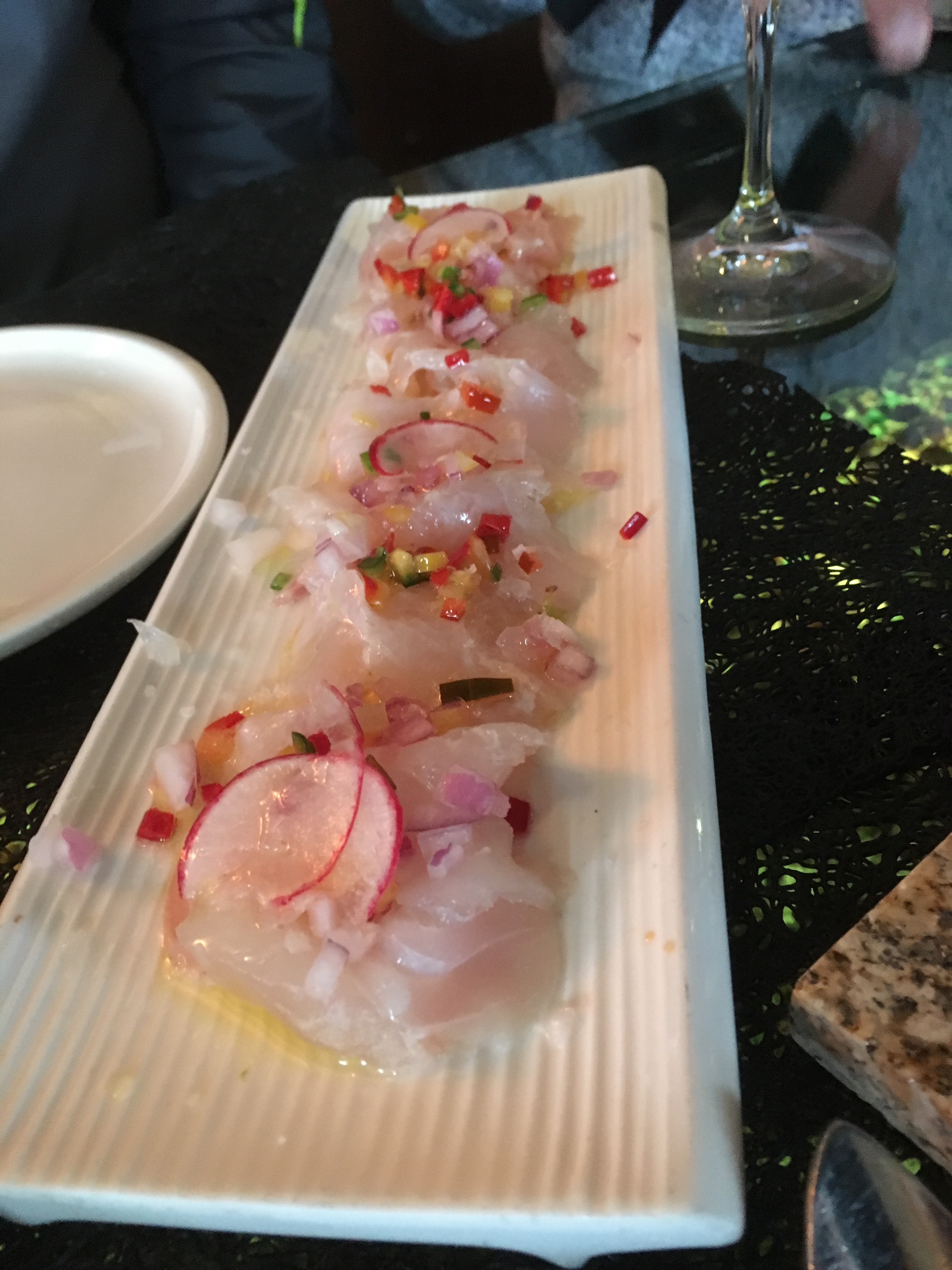
We finished our evening with a unique culinary experience – a prix fixe seafood tapas meal with unusual items- razor clams, oysters, sea bass ceviche, lightly seared tuna with guacamole, mussels, and some things that I could not recognize! We also had an intellectually stimulating conversation with a Scottish couple seated next to us. One of the joys of travel is meeting people from al over the world. It was a lovely end to the day.


And we still ended up with more than five miles walked!

Day 10: Pedrouzo to Santiago: 20.8 km/12.9 miles

This is it – the last day of walking our Camino. We got up at 6:00 a.m. and we were out on the trail by 7 after grabbing a quick breakfast at the small cafe that accepted the breakfast voucher from the pensione. It was actually quite a hearty breakfast – two fried eggs with brilliant orange yolks (not like the anemic yellow yolks from American hens – these Spanish hens are truly free range), choice of bacon or cheese, a slice (or should I say slab) of toasted bread, fresh OJ and cafe con leche.

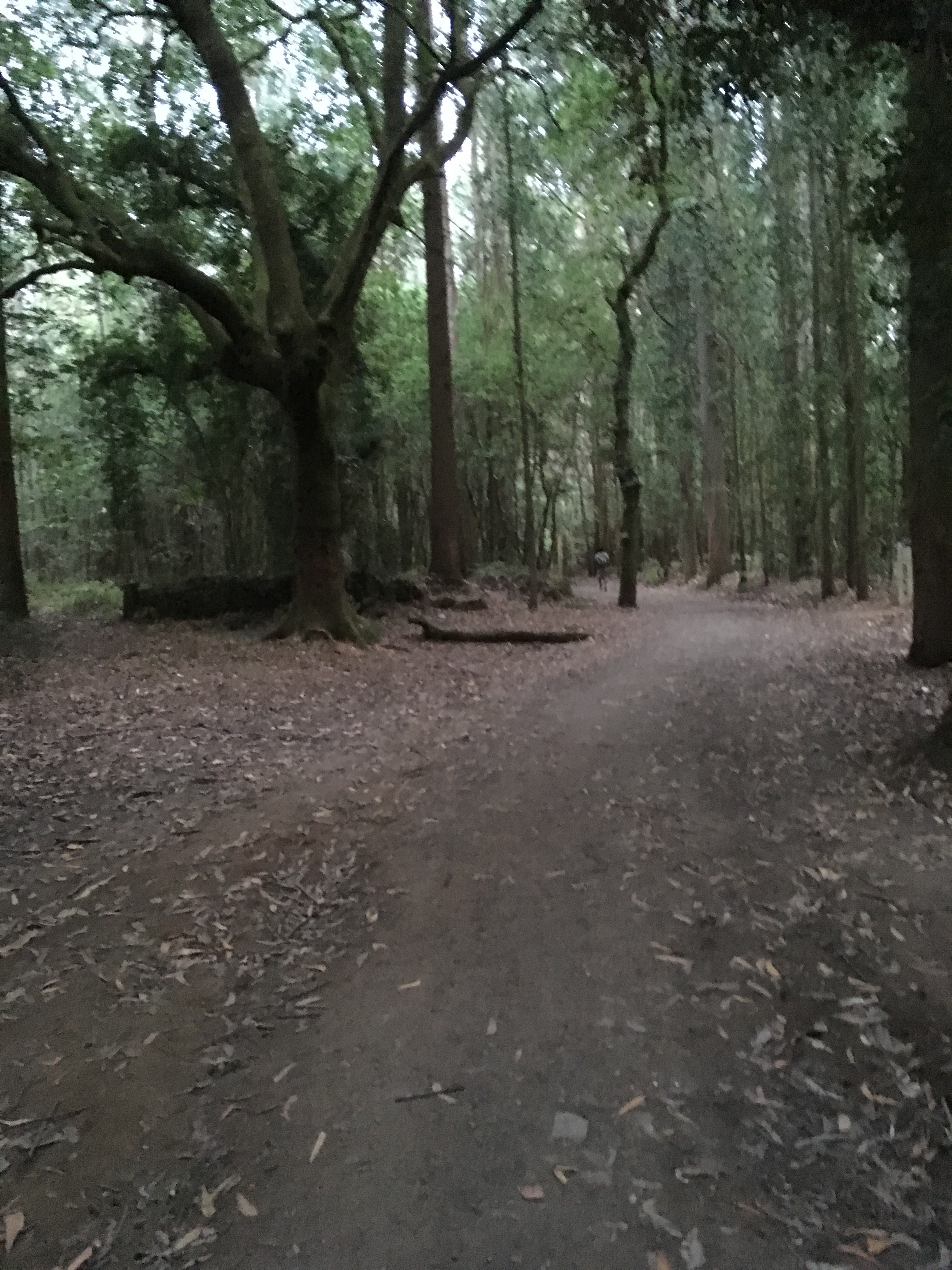
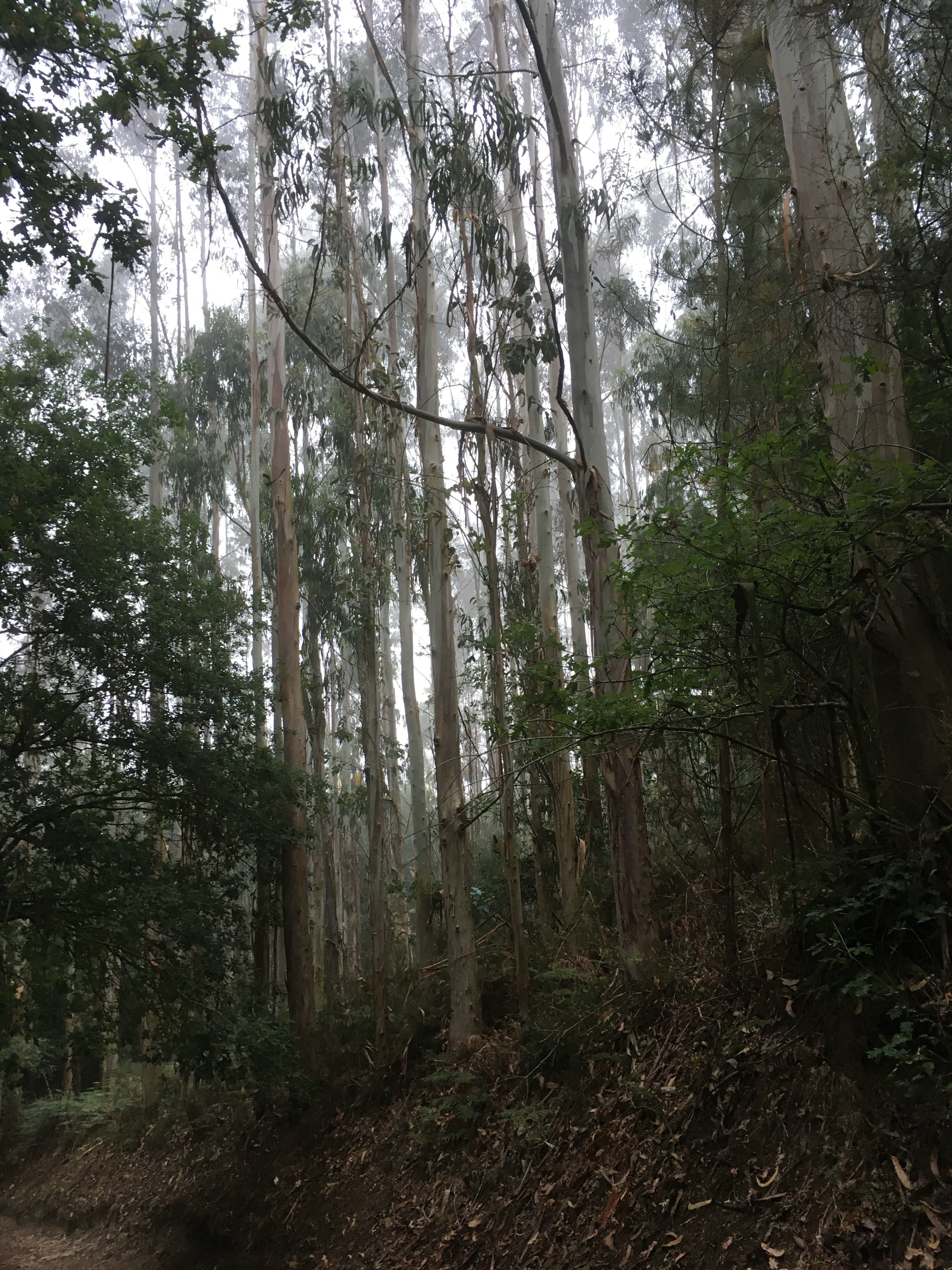
It was a cool and overcast morning (again), barely at the brink of dawn, as we entered the eucalyptus forest. This portion was fairly level although there were several considerable uphill climbs. We were pretty much alone during the initial portion of our walk.

At the first cafe, we watched as at least a dozen “day pilgrims” emerged from a van onto the Camino, crowding into this cafeteria-like building that was obviously designed to service large groups. After this point, solitude was no longer part of the wonderful Camino experience, as packs of daytrippers joined the Way. 

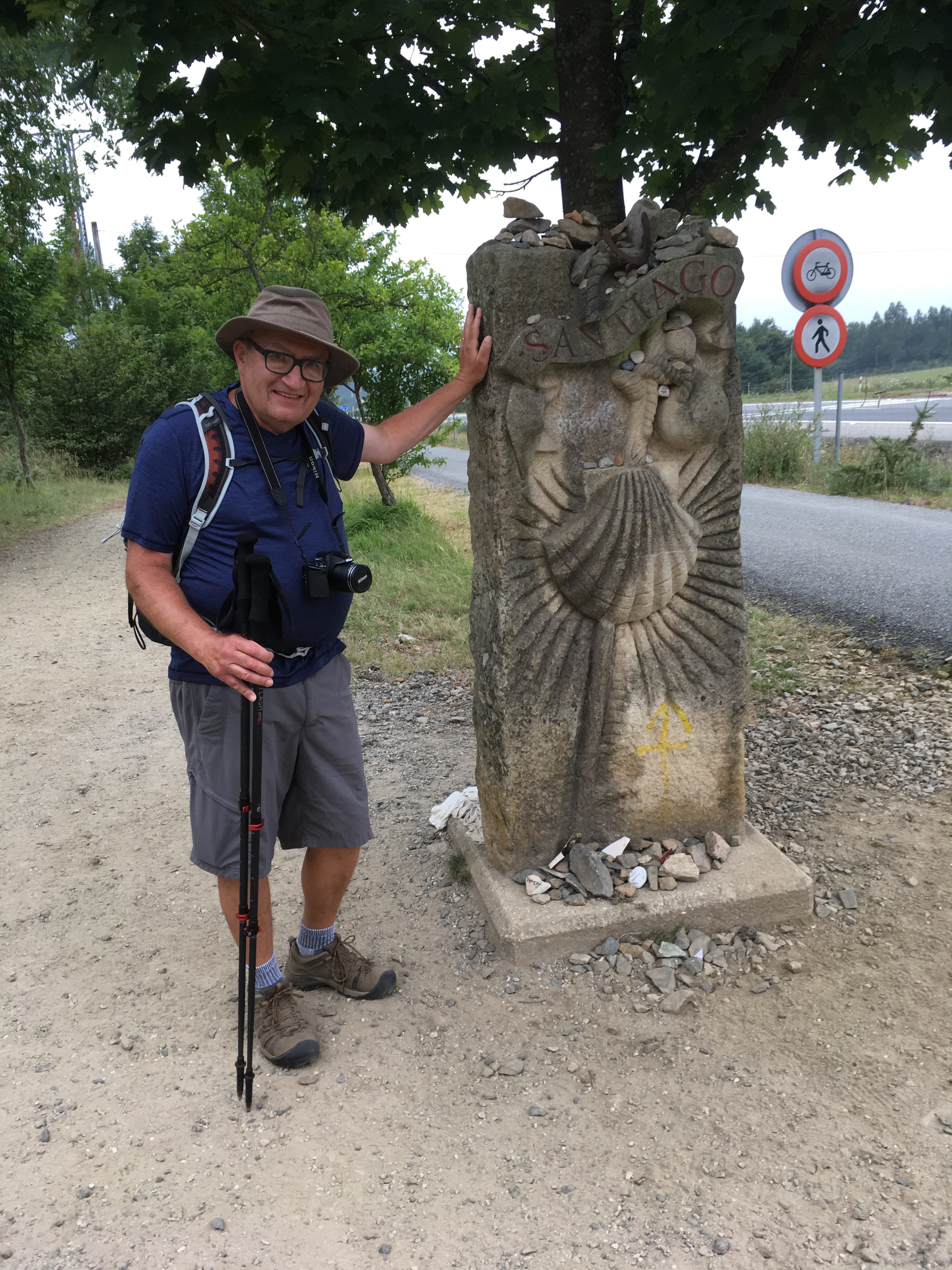
It was obvious that the Camino follows the periphery of the Santiago airport, as jets roared over our heads. At this point, the Camino follows along the shoulder of the major highway. There was a “teaser” statue of Santiago that brought us false hope that we wouldn’t have too much farther to go.


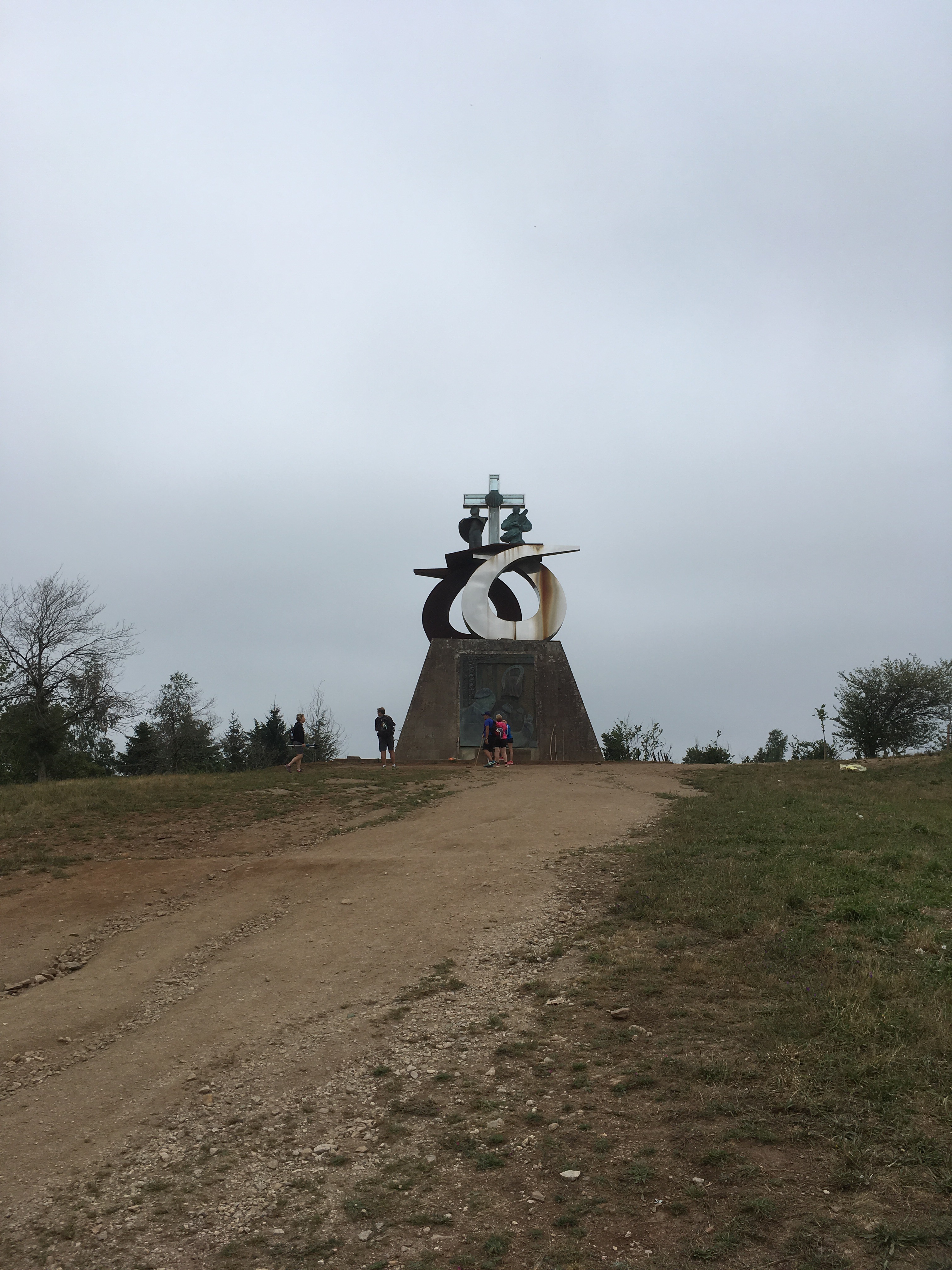
The Camino then veered off along a less traveled road toward Lavacolla. We stopped at a cafe to rest and received a sello for our credencial at the small church of San Vincenzo. There were significant uphill climbs up to Lavacolla (where according to legend pilgrims washed themselves before entering Santiago – it translates to “wash private areas”). We took our last break at Villamaior, where we spoke with an older gentleman from the D.C. area who had started from St. Jean. Then the Camino transitioned into a long boring detour through an ugly industrial area, following along the shoulder of the road. This persisted for several miles, with a gradual uphill grade, until we reached Monte de Gozo (Mount of Joy), where pilgrims used to be able to get their first glimpse of the cathedral of Santiago. Alas, no more, as development of urban blight now obscures the old city until you are almost stumbling upon it! There is a rather undistinguished concrete monument (erected in 1993, I believe, when John Paul II visited) at the top.

Although the serenity of the Camino was lost, at least the final several miles were downhill. We entered what we thought was Santiago, passing over a rickety and long wooden bridge and passing a makeshift shrine, into what was actually an interminably long walk through the suburbs. 

There were virtually no businesses open as it was Sunday ( and therefore nowhere to stop for a break) and the familiar yellow arrows and directional milestones on which we depended for so many miles disappeared. These were replaced by small metallic plaques intermittently embedded into the sidewalk. The map provided to us was woefully inadequate and we had absolutely no idea how far we were from the cathedral. As we had not stopped for a break in over 10 km, we found a bar frequented only by locals where we had a beer and a potty break. We had to share our tiny sidewalk table with a large black scary- looking dog whose owner was at the next table. We were determined to beat out the predicted rain, so we gathered up our gear and trudged onward, not exactly certain that we were headed in the right direction. After a few minutes who should come up behind us, but Brian and Matthew. We were just meters away from the historic center. We were transported back in time with every subsequent step. The strains of bagpipe music could be heard as we approached the portal through which the Camino Francés enters the main square. It’s difficult to describe the maelstrom of emotions – joy, relief, sadness – that hit you all at once when you emerge through the portal and realize that you have joined the confraternity of millions of pilgrims that have preceded you! If was also special because we were able to share this experience with our new friends/Camino family, Brian and Matthew.

We decided to head to our hotel to shower and rest prior to obtaining our Compostela from the pilgrim’s office. We stopped at the tourist information office to get a better map and directions to the hotel. The Hotel Virxe da Cerca is at the edge of the historic center. It is built into a hill and has several levels, with a charming garden area and lovely common spaces.

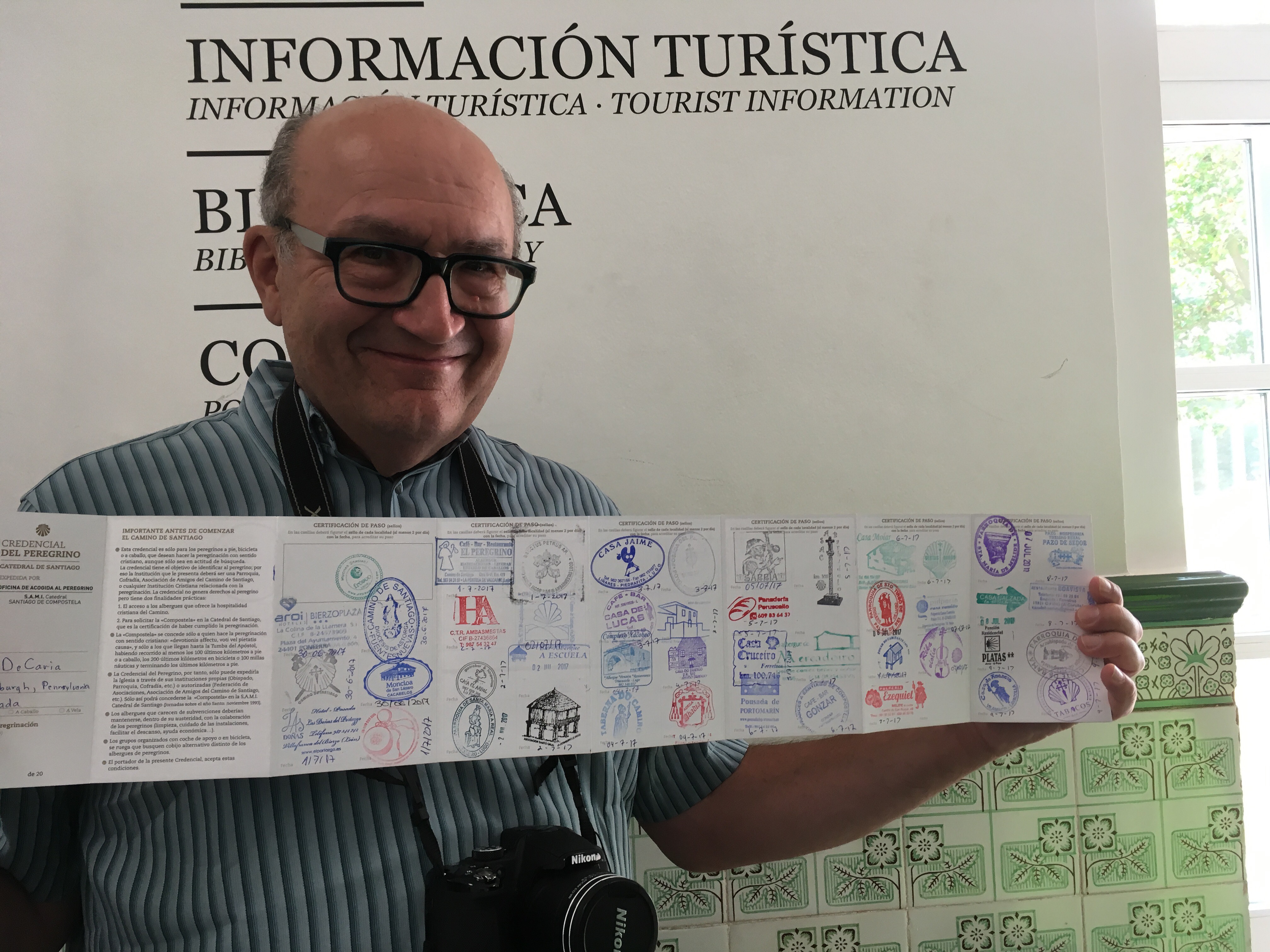
Cleaned and rested, we joined the queue for our Compostela, completed credencial in hand, feeling the exhilaration of accomplishing our goal.

Familiar faces, even if we didn’t know their names, from our time on the Camino were around us. It was a truly joyful and uplifting experience.

We then attended the 7:30 pm pilgrim’s mass. It was a moving experience, and difficult to put into words. To see so many people from different parts of the world gathered together in peace and love gives some hope that humankind may be able to overcome our differences.

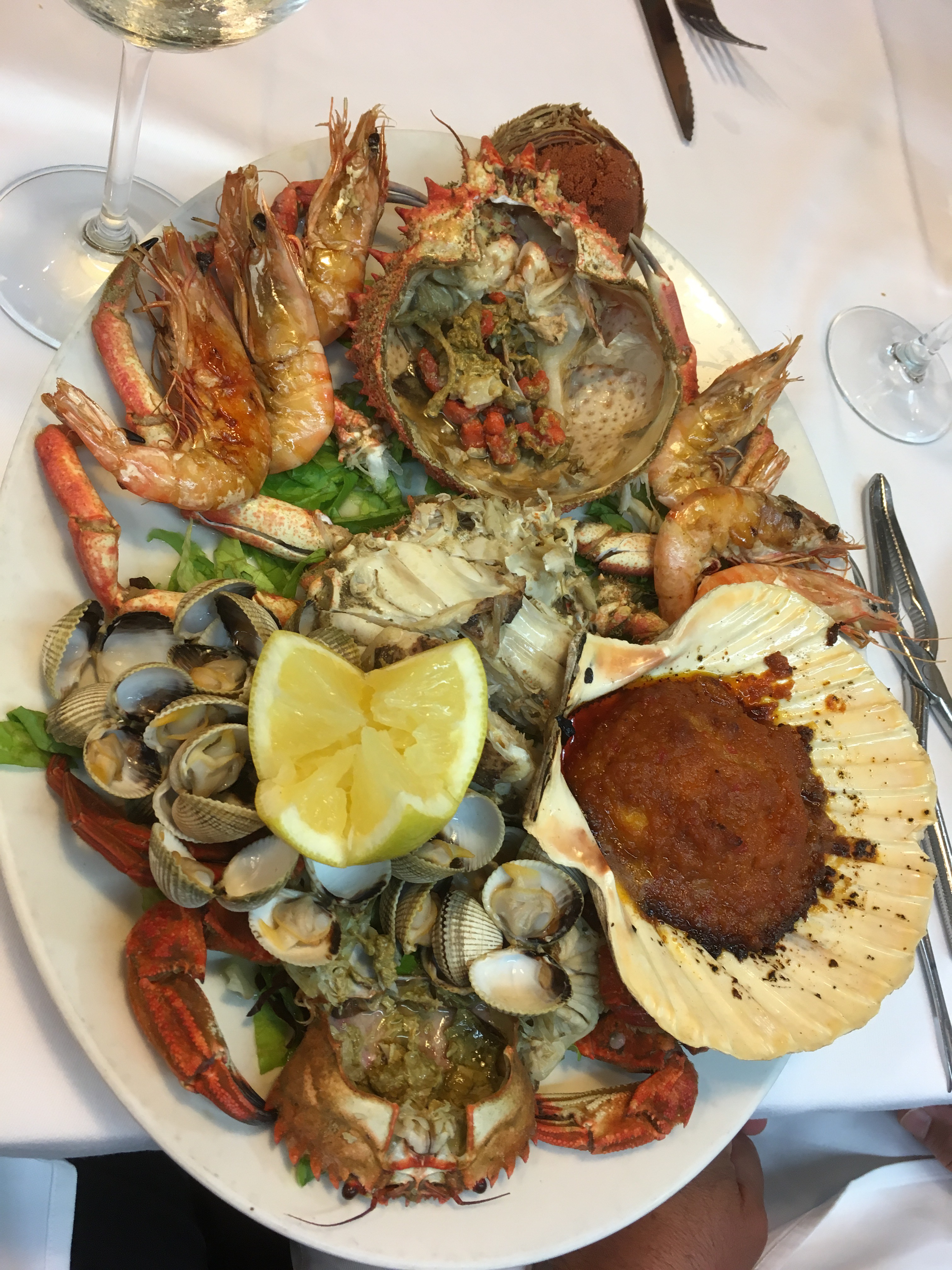
After mass, we wanted to treat ourselves to a good meal, not the standard pilgrim’s menu we’ve been consuming for 10 days. Seafood was what we were craving!

We had a great waiter (from Paraguay), great company (Brian and Matthew) and a great meal. What an end to an incredible day!

Lesson of the day: This isn’t the end; it’s the beginning.

Day 9: Castaneda to Pedrouzo: 24 km/15 miles

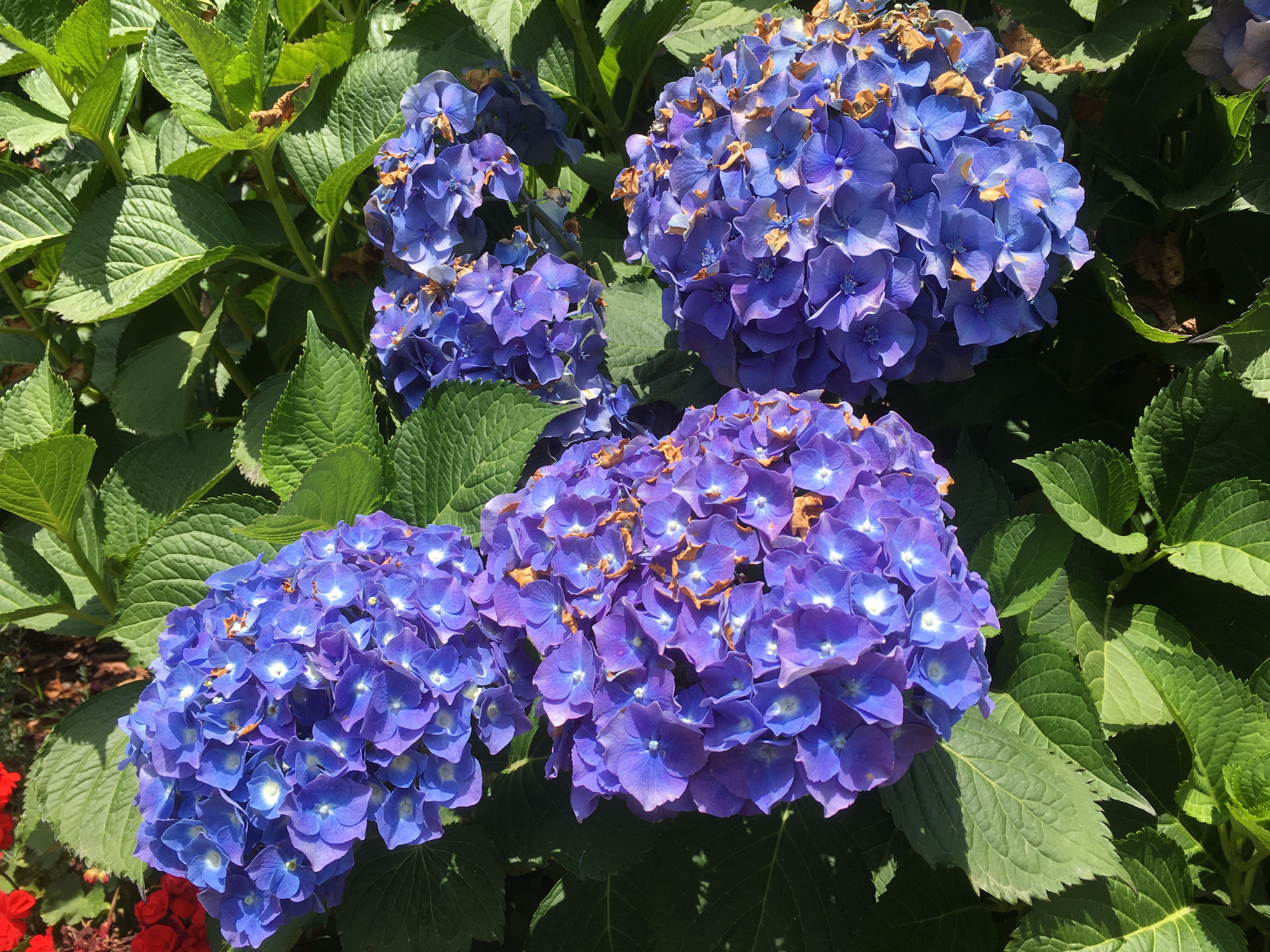
We’re almost there – only 44 km/28 miles to Santiago! After a lovely dinner last night at our historic and luxurious accommodations (Pazo de Sedor- a 17th century manor house), we woke up refreshed and ready to hit the trail. Unlike the past several mornings when we left early without breakfast, we decided to hang around until 8 a.m. and enjoy a more relaxed morning. We left around 8:30, about an hour later than our usual departure time. Since our hotel was off the Camino, this added an additional three-quarters of a mile to our mileage total for the day. Unlike the past several days, there was no mist and no significant humidity and the temperature was pleasantly cool. There were times of clouds and sun with no risk of rain. Once we got back onto the Camino, the trail was in the forest and of course we started with a pretty steep ascent. A bathtub was spotted off in the trees, possibly a relative of the toilet we saw several days ago! We crossed a stone bridge over the Iso River into the charming village of Ribadiso. After we passed through, the Camino wound its way uphill along a highway. We slowly climbed for a distance of 3 km to the small city of Arzua, the largest one we will encounter before reaching Santiago. We walked along the Main Street of this bustling town, lots of people out and about doing their shopping, enjoying a cup of café, and window shopping. After traversing the entire length of the town, the Camino veers to the left just before a small tranquil park. It continued down through a residential area with cobblestone streets and then out into the countryside. There was a huge slug hanging out on a roadside fountain. Free range chickens were everywhere. Flowers are everywhere with the most amazing hydrangeas growing along the entire Camino.We passed fields of corn and cattle grazing. Around Pregontono, we encountered a cattle traffic jam on the Camino as an elderly woman wearing Wellingtons and carrying a stick guided a small herd of dairy cows down the trail. She held a lead rope attached to the last cow in the line of bovines because it became quite evident that this particular animal was not the “sharpest tool in the shed” as it constantly tried to veer away from the rest of the herd!

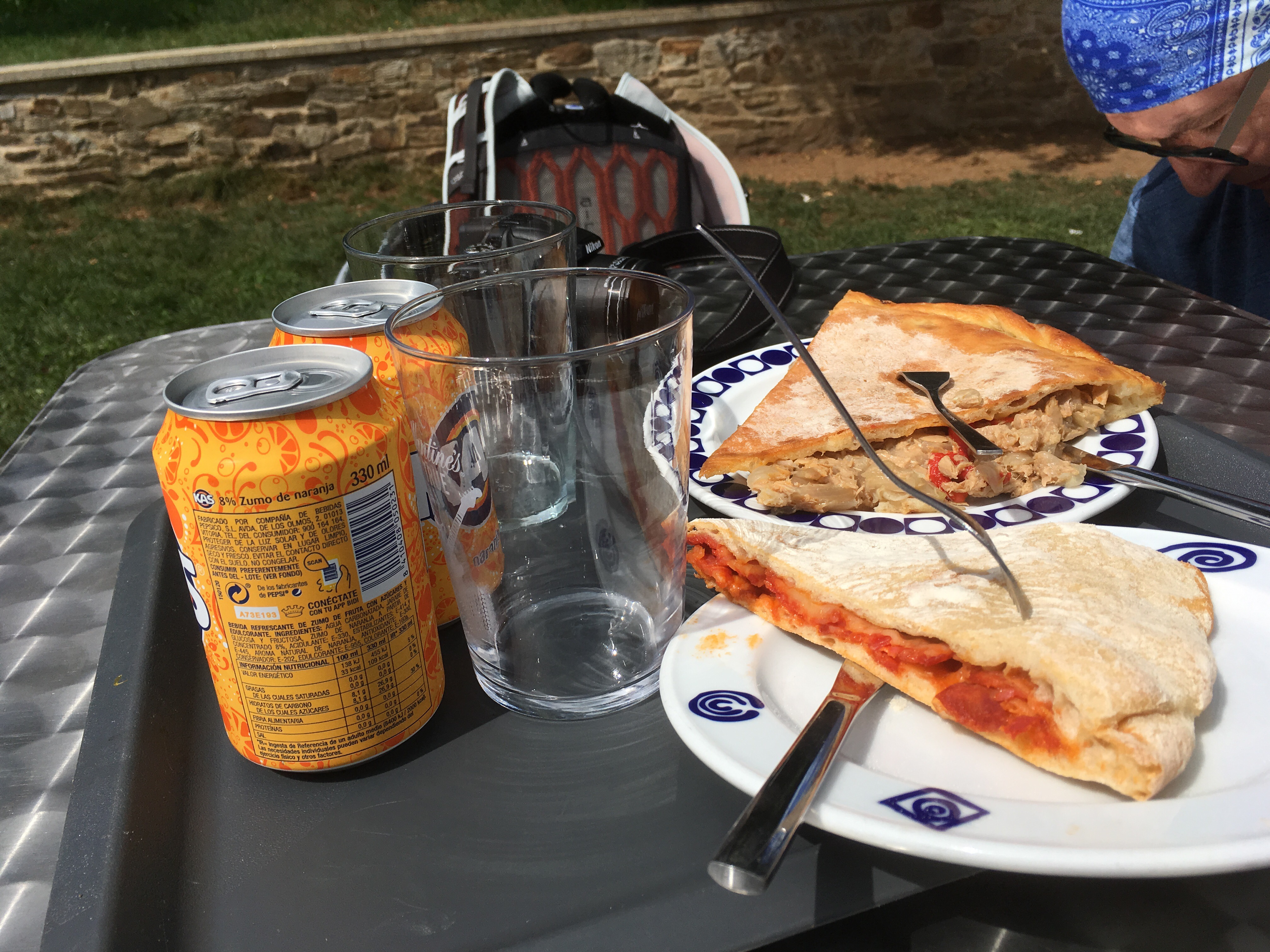
We took our first rest stop about 8 km after our start, quite late for us as we usually can’t hold out that long without some nourishment and a potty break. Instead of our usual bocadillo, we enjoyed tuna and chorizo empanadas. This is a Galician specialty,  a little like a calzone but flatter. As we watched pilgrims lumbering past, two young men riding white stallions decided to stop at the café for their lunch. We never saw them later on so I suspect that they weren’t riding all the way to Santiago.

The Camino in this stage alternates between wooded areas of oak and eucalyptus where one hears the constant hooting of unseen owls and acres of cornfields. We saw a few sheep in addition to the preponderance of Holstein cows. There were no more gigantic uphill climbs or treacherous descents for the most part, just an undulating trail. At one point we heard loud gunshots that was followed by the sound of trucks blowing their horns for at least 10 or 15 minutes. I suspect that this was likely related to a truckers strike. As the wooded Camino trail paralleled the highway, this cacophony totally overwhelmed the sounds of nature.

We stopped for a couple more refreshment (orange Fanta and the requisite cerveza) and rest breaks, as we are feeling the cumulative effects of walking about 15 miles per day for the last 9 days.

This stretch of the Camino was unique because of the many examples of expressions of hopes and desires of humans. We encountered the “Wall of Wisdom” along the way. A local philosopher posted (in English and in Spanish) religious and philosophical statements and questions, meant to make the pilgrim reflect on his/her faith and beliefs. Additionally, the Camino milestones are covered with graffiti that frequently try to encourage other pilgrims to continue onward. One ingenious graffiti artist wrote the lyrics, one line at a time, of John Lennon’s song “Imagine” on the outside of blue trash barrels that had been placed along a stretch of the Camino.

As the day progressed, we were finding it increasingly difficult to keep putting one foot after the other. Thankfully the majority of the Camino was shaded, but even small hills seemed too much. The last 3 or 4 km according to our map seemed like it would be an easy descent to our final destination, but it seemed to go on forever! We had to get off the Camino again to find our pension in the unattractive “town” of Pedrouzo, a conglomerate of crummy pizza joints, tourist trap restaurants, Camino souvenir shops, utilitarian lodging establishments and a sketchy “supermarket”. Unfortunately we had to walk about 500 meters along a very busy highway to get there. We made in one piece, hot and very dusty, about 9 hours after we started. We finished our evening sharing dinner with Brian and Matthew, dad and son experiencing the Camino together. But I don’t think they were brave enough to try our ensalada especial. It had everything but the kitchen sink (tuna, ham, fried egg, pineapple, white asparagus, iceberg lettuce, tomato, olives, onions and these little wormy things, possibly baby eels).
Lesson of the day: The world is full of distractions. When we rush through our day, we don’t take time to see things. Take time to really see your world. And watch out for little “worms” in your “special” salad!

N.B. I’m having difficulty uploading photos and will retry tomorrow. You won’t want to miss seeing those little wormy things in that especial salad😉!

Day 8: Palas de Rei to Castaneda: 24 km/about 15 miles

Today was going to be challenging distance-wise, as it is a 15 mile stage, although it didn’t look like we were going to have as much change in elevation, according to our map. So we were out on the Camino, just after sunrise before 7am.  This isn’t actually considered THAT early because the pilgrims staying in the municipal albergues were out well before 6 am so they would be assured of a dormitory bunk at their next destination.

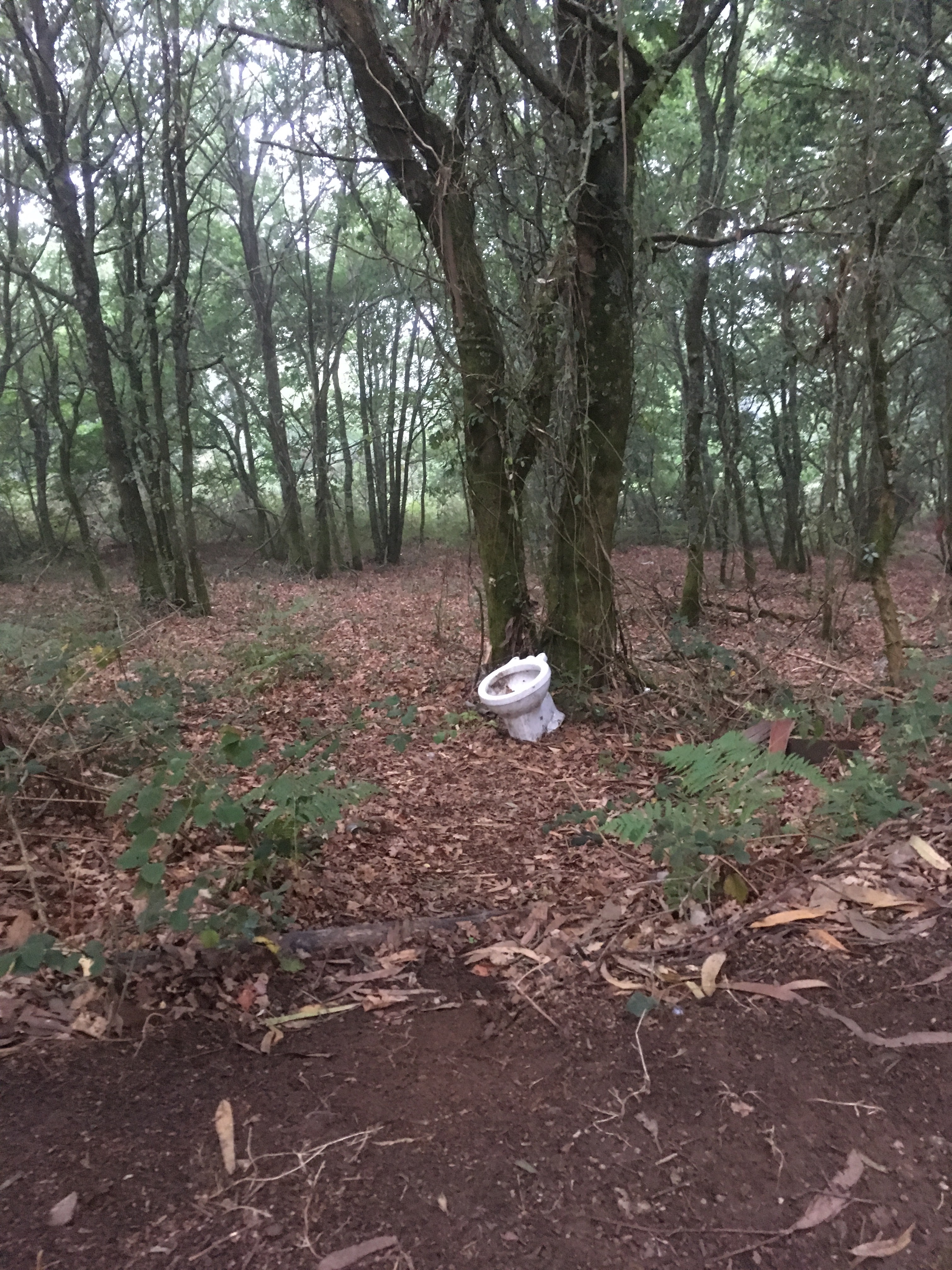
It was an overcast, cool and misty morning (again), but it felt warmer than the actual temperature because of the high humidity. We started out of this charming and bustling little town, following a highway, and then promptly the Camino diverted off into an ethereal forest full of eucalyptus trees. We did however spot something a bit unusual – a toilet plopped (excuse the pun) into the middle of this mystical scene. I’ll leave it up to you to figure out the symbolism (I don’t think that there is any religious connection)!

Although the trail grade was initially flat, we were quickly back to the ups and downs of the last several days. With all the physical exertion in concert with the high humidity, we were pretty drenched in perspiration by the time we reached our first rest stop about 5 km into the walk. A couple of OJs and a pan au chocolat later, we were back out on the Camino. Since the first wave of pilgrims (staying in albergues) had left hours before and the next wave of pilgrims staying in hotels had not left yet, we were pretty much alone for long periods of time.  One could really listen to nature, the wind rustling through the trees and the incredible symphony of birdsong that permeates the Camino. Of course, occasionally a group of students (they looked to be of middle school age) would come barreling down the trail, their trekking poles clacking away and their enthusiasm focused more on socializing rather than appreciating the Camino experience. The sound of the piercing whistle used by their chaperone kept them in line, but really sort of ruined the ambience.

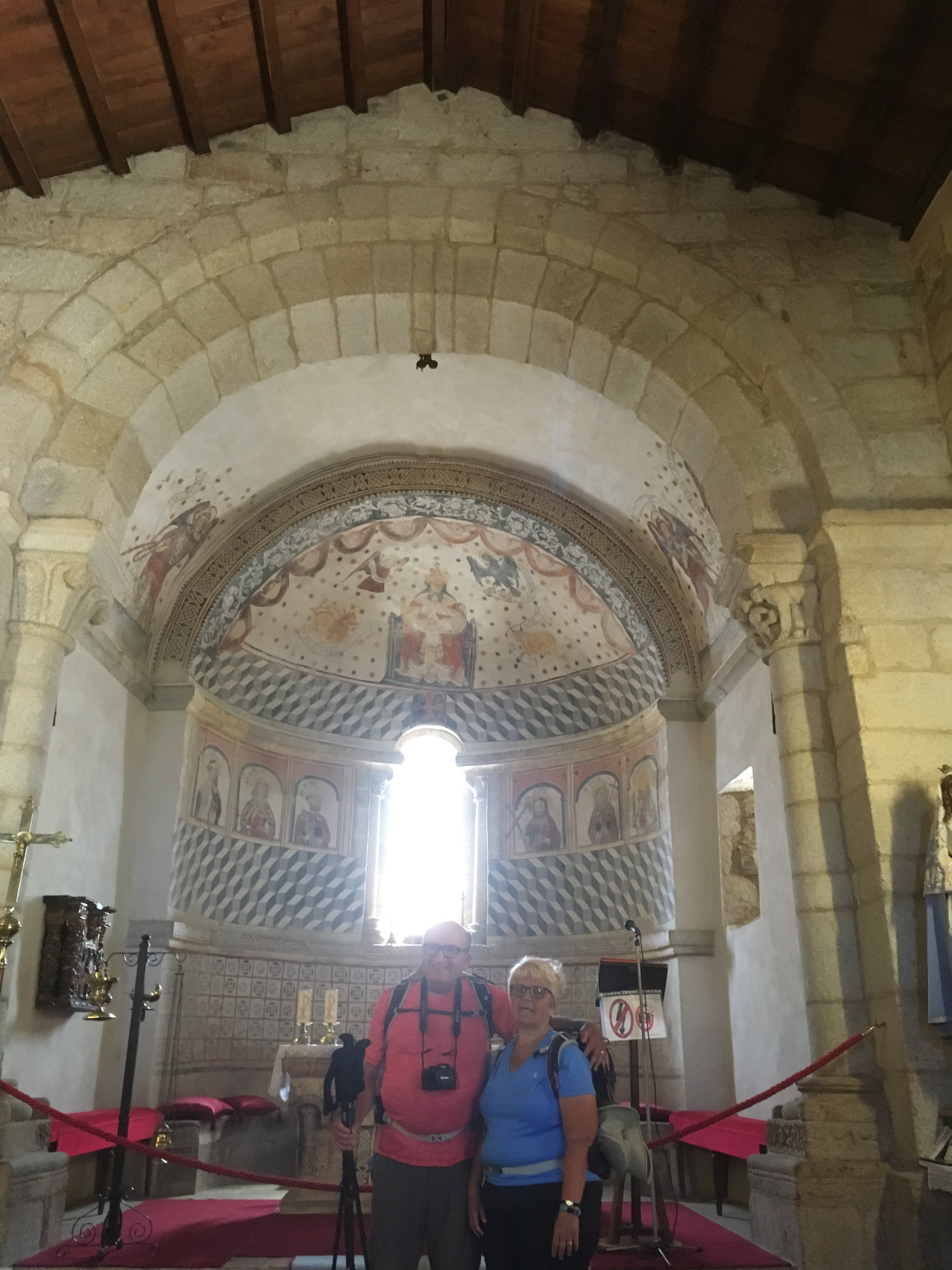
Today was a mixture of forest trails, walking along a highway, and strolling through small farming villages, with a mid afternoon interlude in the small city of Melide, famous for octopus restaurants (pulperias). It was a bit disorienting to be in an actual city. The ever present yellow arrows designating the Camino route became more challenging to discern amongst all the other signage. After a brief lunch break for octopus (Tony really wanted to have some), we found our way out of Melide. We passed by a 12th century church on the outskirts where a volunteer beckoned us in. He proudly shared with us (in broken English mixed with Spanish) the history of the altar, statuary and baptismal font. And we received a wonderful sello for our credencial. 

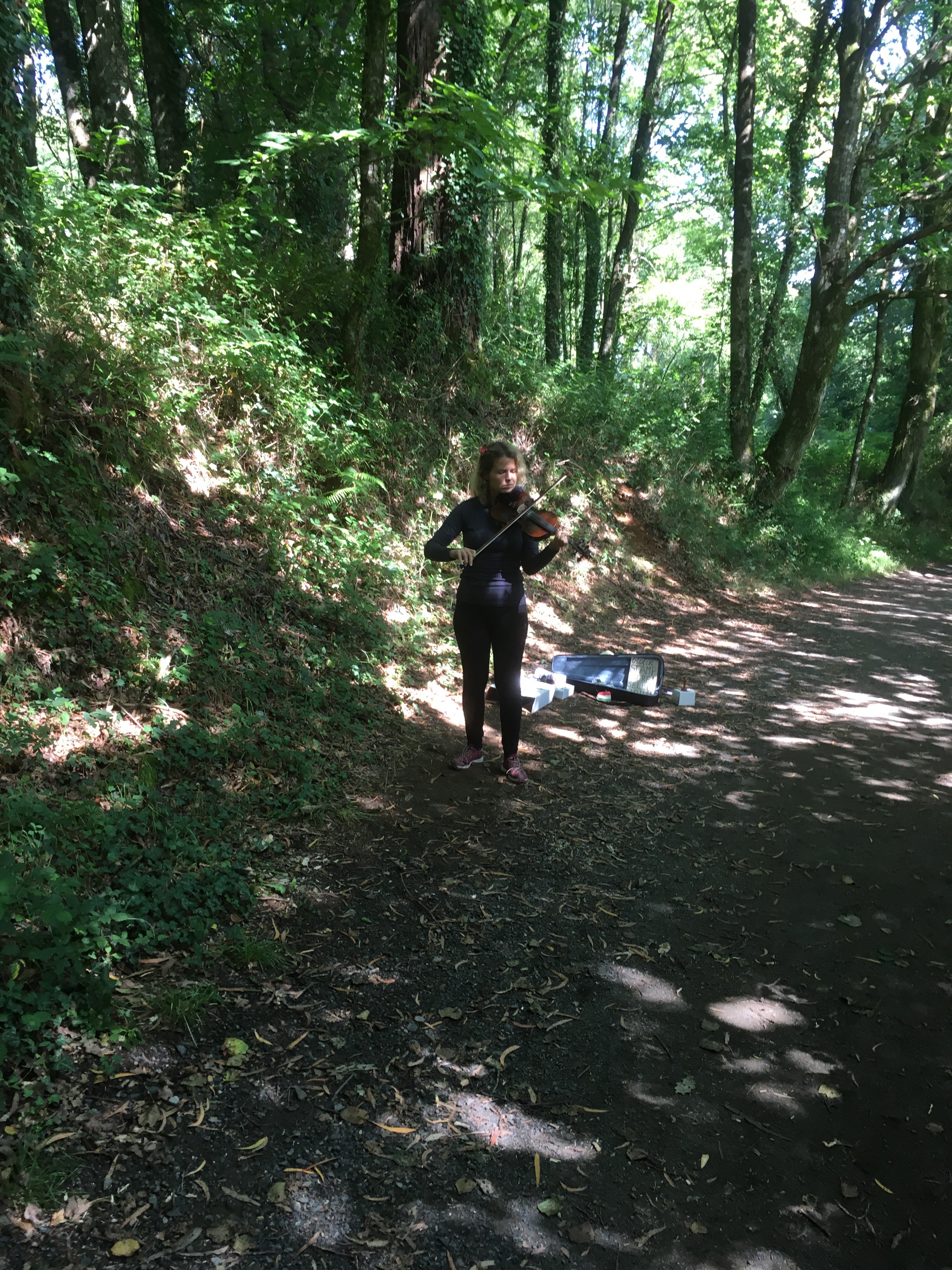
The remainder of this stage of the Camino, according to our map, was “supposed to be” fairly level. WRONG!!! Although it was quite beautiful amongst the oak and eucalyptus trees, the forested trail had some pretty impressive up and down hills. It was quite taxing. But despite our physical discomfort, we were treated to wonderful gifts that we would have never seen if we were flying by in a car instead of walking. There was a lovely stone bridge crossing over a stream in the forest that was,at least for balance-challenged me, a bit scary to cross. We saw a stork, a heron, horses, cats, dogs, cows, a huge slug and snails along the Camino and we were treated to a violinist playing a piece that had a Celtic feel while we were traversing the wooded trail.

We have discovered that the final 5 or 6 km of the day are the hardest. The cumulative effect of walking 14-15 miles per day is taking its toll. We seem to hit a wall at the 10 mile mark and it is a struggle to get through those last few miles. It was especially difficult today because our hotel (actually a restored 17th century manor house) was about a half mile off the Camino. And it was at the top of a fairly substantial hill! As we lumbered up the road toward our hotel, an elderly gentleman rushed out of his house to inform us that we were going in the wrong direction. We actually were not, but since we were off the Camino he thought we were a couple of pathetically lost pilgrims!

Lesson of the day: Be attentive to the world around you. Listen and look and you will be given wonderful gifts.

Day 7: Portomarin to Palas de Rei: 27 km/ almost 17 miles

This was going to be a long day of walking so we were up bright and early and at breakfast by 7am. On the Camino by 7:15, we followed a group of teens who appeared to be part of a religious group as we were leaving Portomarin. The village was moved to its present site in the mid 1960s after the original town was submerged under water after the Mino River was dammed (see last post). We walked past the church that was carefully reconstructed on its new site at the center of town after each original stone was meticulously numbered. Portomarin  is unlike any of the other places we’ve seen in Galicia because every building is relatively new, except for the entirely reconstructed church.

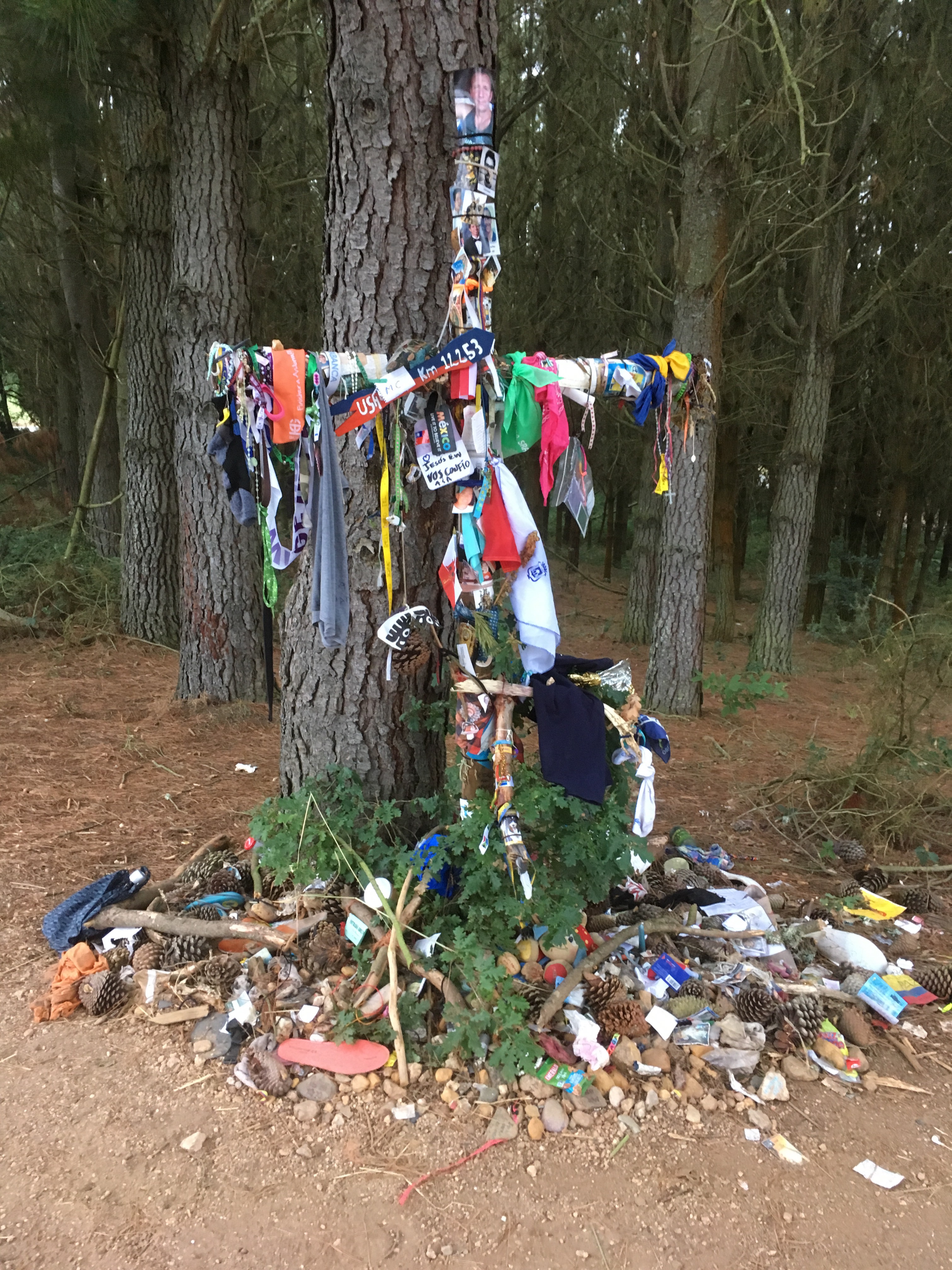
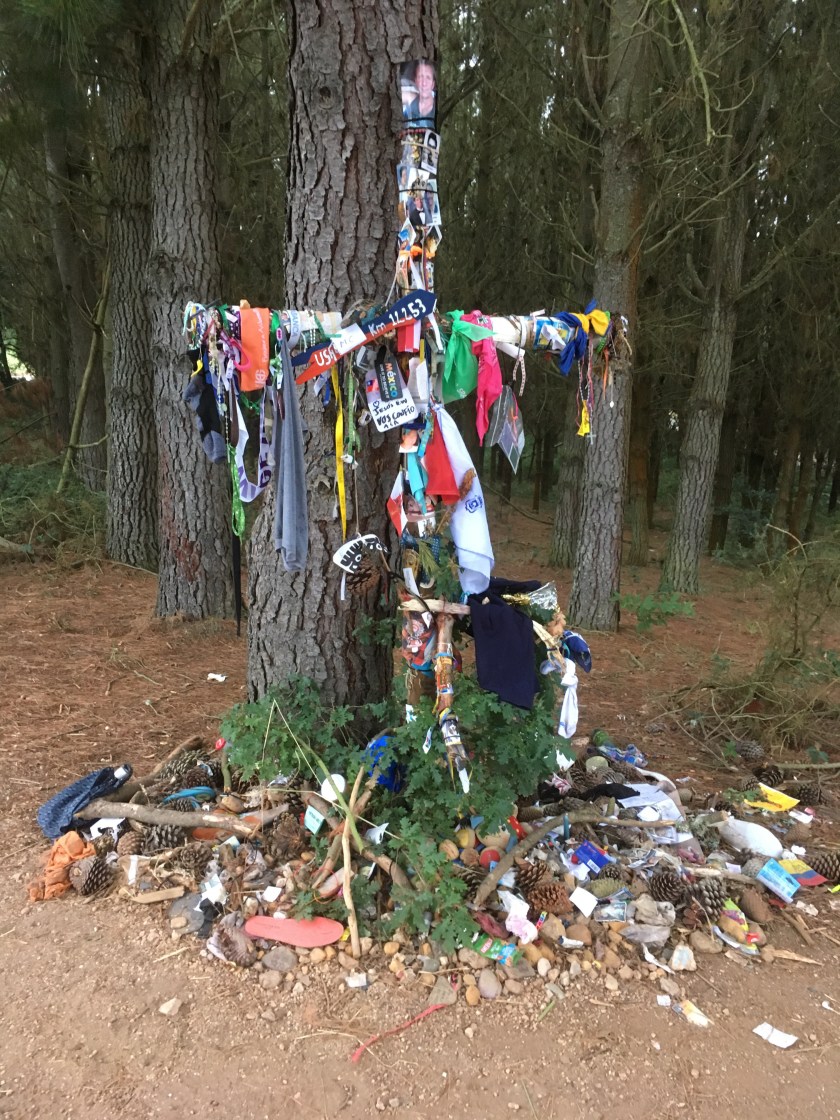
In addition to the piles of stones placed on the Camino mile markers, we have begun to see more and more makeshift shrines, usually in some form of a cross, along the Way.  These symbols of faith stir the soul. It truly embodies the reason for embarking upon this journey.

The first part of our Camino today was a continuous 8 km uphill climb through wooded areas and cornfields. The misty and cool weather was pleasant at first, but the difficulty of the ascent resulted in a ridiculous amount of physical exertion, and perspiration soaked our supposedly moisture wicking clothing. Two hours of huffing and puffing our way up to the crest passed before we were able to take our first refreshment and relaxation break. As this café was the first one on this stage of the Camino, it was overrun by pilgrims, getting their first jolt of caffeine from a café con leche. We nabbed one of the few free tables and purchased a couple of OJs and a pretty pathetic cellophane wrapped Spanish version of pan au chocolat. Drenched in perspiration, the cool temperature made it quite uncomfortable, but we had many more kilometers to walk.

After a short respite and a bathroom  break ( and getting a stamp for our credencials), we rejoined the groups of pilgrims on the Camino. We met up with Patrick again. He is still diligently working his way along the Camino. As is his routine of late, he walks until he can go no further and then grabs a taxi to the next town.

After many kilometers of ascent, the Camino finally emerged onto a meadow of wildflowers. And the sun finally burned through the mist. It brought back memories of Julie Andrews in the opening moments of “Sound of Music” . If was truly a glorious sight to behold, after so many hours clogging up through the fog. 

We had another long ascent before we took a lunch break of Gallegan cheese and tomato bocadillo, potato chips and two large cervezas. Since we are slow pokes compared to the other pilgrims, we were out of synch    with the waves of pilgrims, so we had the place to ourselves.

Subsequently, the little hamlets appeared at frequencies of 2 to 3 km. They were quite similar – a few stone buildings, barns, cows and dogs ( mostly of the German Shepherd variety). We frequently saw horreos, cement structures for grain storage built off the ground to prevent rodent infestation.

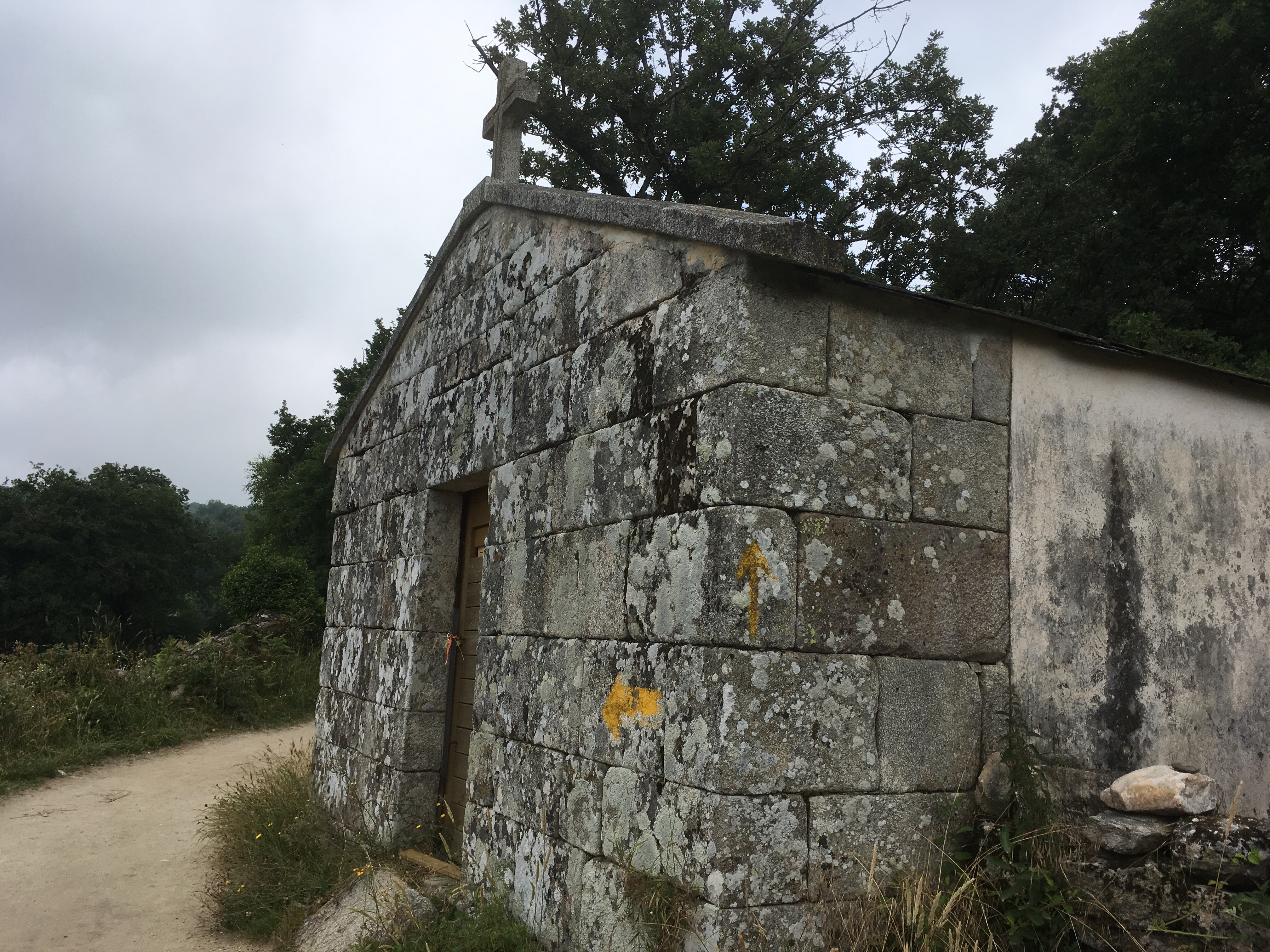
In the little town of Ventas de Naron, we passed a tiny 12th century church in which a blind hermit was stamping credencials. He was so loving, speaking to us in a Spanish and Italian hybrid language, shaking  our hands and wishing us a “buen Camino”. We have seen many similar churches in the past 150 km of the Camino, but this was one of the few that one could enter. Outside the church, there was a cruceiro, a cement cross with the Pieta represented on one side and the Crucificion on the other. 

The Camino progressed over a highway bridge, onto areas that traversed cornfields, entered forests of oak trees and paralleled the highway. Instead of dodging cyclists, today we focused on dodging Spanish drivers who seem to like to see how close they can get to pilgrims without actually hitting one!

Menacing clouds  overtook the skies that were so recently gloriously blue, and thunder could be heard in the distance. We picked up our previously snail-like pace, hoping to avoid getting caught in a downpour. Alas, we were not so lucky and we had to scramble to don our ridiculously expensive “high tech” ponchos that were purchased at REI. Tony almost strangled himself with the camera strap as he tried to figure out how to get the poncho over his head and his backpack at the same time. Luckily, there was a café within a couple hundred meters and we were able to avoid the deluge that quickly ensued. While waiting out the storm, we spoke with a woman from California who was suffering from a really bad case of shin splints. She had started her Camino in Burgos, about 300 km earlier and was quite concerned that she would be unable to finish these last 60 km. We have heard similar stories, of injuries that prevented pilgrims from reaching Santiago on foot. We hope she is able to continue on! 

The last couple of kilometers have consistently been the most difficult. Exhaustion, both mental and physical, seems to set in after about 10 miles (16 km). Sometimes it is the thought of a cool(or warm) shower and a comfortable bed that keeps you going toward your goal. That certainly was the case today. We were wet and the blisters on my feet didn’t appreciate my damp socks. The sight of Palas de Rei appearing in the distance was a huge relief. We hobbled into this lovely and lively town filled with albergues, small hotels, and restaurants. The church of St Timos was even open and a volunteer was stamping credencials.

After a shower, change into clean clothes and a quick check of emails (yay, we have WiFi), we did our laundry in the albergue across the street. While waiting for the wash cycle to finish, it was time to relax and enjoy  a large cerveza in the bar of our pensione. Tapas were served to us as we chatted with Diana from Australia and Betsy and Charlie from South Carolina. Then it was off to dinner ( a pilgrim’s menu at 9.5 euros for three courses including wine). Tomorrow will be an early start again as there is more rain predicted.
Lesson of the day: Having a simple goal every day makes it easier to get through the challenges.
Day 6: Sarria to Portomarin: 25 km/14.7 miles (Will my feet survive?)

Today we joined the hoards of pilgrims who start their journey from Sarria. To receive a Compostela ( a document from the Catholic Church that historically granted plenary indulgences but now just states in Latin that you completed the pilgrimage to Santiago), a pilgrim must walk 100 km or bike 200 km for spiritual or religious reasons. Ergo, the majority of pilgrims start in Sarria, 114 km from Santiago. Since we will have walked over 200 km, perhaps we should get some extra credit, what do think?

So we were off at 7:30 am, hoping to beat out the precipitation predicted for this afternoon. As the days have progressed we seem to be proceeding more slowly, as we have discovered aches and pains in muscles we didn’t know we had. And I deserve a Guinness book of world record in the number and dimensions of blisters an individual can develop in less than a week on the Camino. 

The weather was much like Ireland – cool, overcast, and misty. We crossed over the Sarria River and headed uphill (of course!) through this charming little city of 16,000 inhabitants, turning right past a monastery and over a medieval bridge, to join the trail. We passed fields of corn and wheat, crossed railroad tracks, and continued through stands of oak trees. We stopped for breakfast (cafe con leche and cake – we’re in Spain, remember?) at a small cafe in Vilei, after a crowd of pilgrims had just left. It was quite a set-up: great location, café, souvenir shop, albergue and the requisite rest room! It was there that we first encountered a young Korean woman who seemed to stop at every cafe that we did and walked at about the same pace – really slow!

This was a day of hiking through farms, cattle grazing areas, wooded areas, and a significant amount of uphill climbs. And a day of almost always encountering groups of pilgrims who had obviously started from Sarria, as they only carried small day packs or just trekkkng poles. It was also was a day of dodging cyclists who somehow are able to ride these steep and rocky trails. And I mean really big rocks, the kind that would cause one to twist or break an ankle! There were also areas where we crossed small streams via primitive rock bridges.

As we hiked through the fields, we heard strains of bagpipe music. As this part of Spain has a Celtic heritage, it was lovely to see a man playing a bagpipe (quite beautifully) here on the Camino raising our spirits, like his music, to the heavens.

It never did rain. In fact, the sun broke through the clouds during the mid afternoon. We stopped four times, to rest, consume huge amounts of fluid (predominantly orange soda) and potato chips (a great source of salt) and to rest our feet. Despite the cooler temperature, the humidity was such that one began sweating profusely with effort – and there were lots of hills to climb the first half of the day’s route. We met up with Diana from Australia and Charlie and Betsy from South Carolina several times today, usually at one of our rest stops. We may be hitting a wall today, as we were moving verrrrry slowly. The worst part was (get ready, this is disgusting) my enormous blister on the left heel decided to rupture and a huge new blister formed on the sole of the same foot. But somehow you keep on going through the initial burst of pain and maybe it’s not as bad as you expect. 

We passed our halfway point to Santiago (the 100 km marker) today and it’s downhill (not literally) from here. We will be in Santiago in four more days!

We could see Portomarin in the distance. The town was totally rebuilt in the 1960s after the Mino River was dammed up, submerging the original town that originated in Roman times. In fact, when the water level is low, the ancient Roman bridge can be seen near the present day bridge. Our hotel is the Pousada Portomarin, way up at the top of the town, so we got to climb up, up, up again! It appears to be a converted monastery or convent with a charming lobby, lovely hardwood floors and no air conditioning in the rooms! It’s 83 degrees in the room and the opened windows are useless as there is absolutely no breeze! We had dinner at the hotel restaurant, joining Brian and Matthew from New Jersey. We have truly enjoyed their company. Pleasant conversation accompanied our pilgrim’s menu of caldo Gallego (a kale soup), the Spanish version of a salad, an interesting fish casserole and a Spanish version of lasagna. The off to bed, as we are planning an early start (hopefully 7:15 am) as we have 15 miles to cover and we want to beat out the predicted precipitation.

Lesson of the day: A blister is a lot like all the angst we carry in our lives – once the blister bursts, it hurts like hell for a while, but you work through the pain and keep on going with your life’s journey.

Day 5: Triacastela to Sarria (almost halfway point): 16.7 km/10.6 miles

This should be like a stroll in the park, only 10.6 miles, right? Well, we are in the midst of a heat wave and today Galicia bore absolutely no resemblance to Ireland weather-wise! We left Triacastela at 7:45 am, a bit later than we would have preferred, but the miles and last night’s shall we say uncomfortable bed took their tolls. It was like sleeping in a marshmallow valley, kept rolling to the depressed center of the bed!

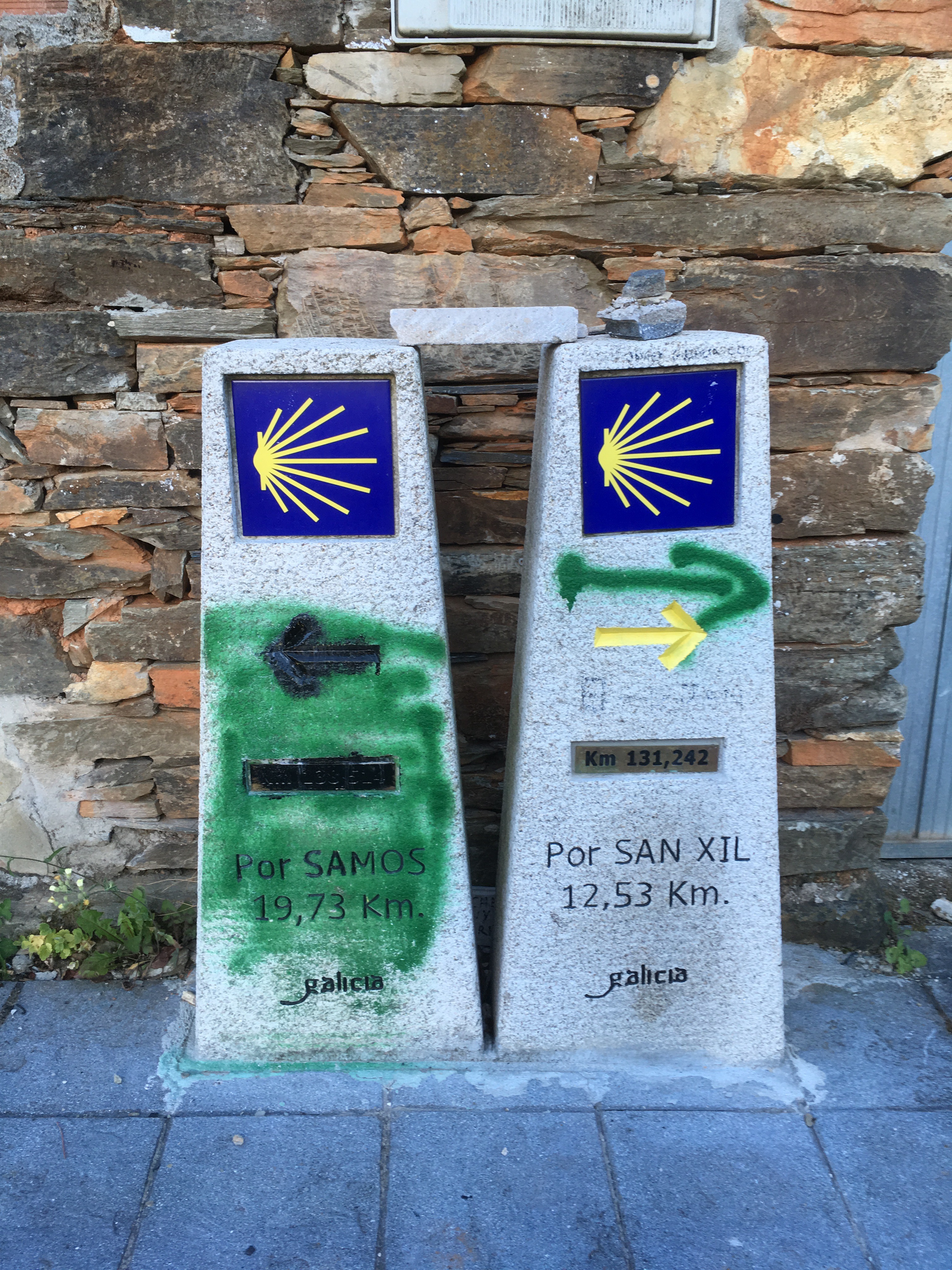
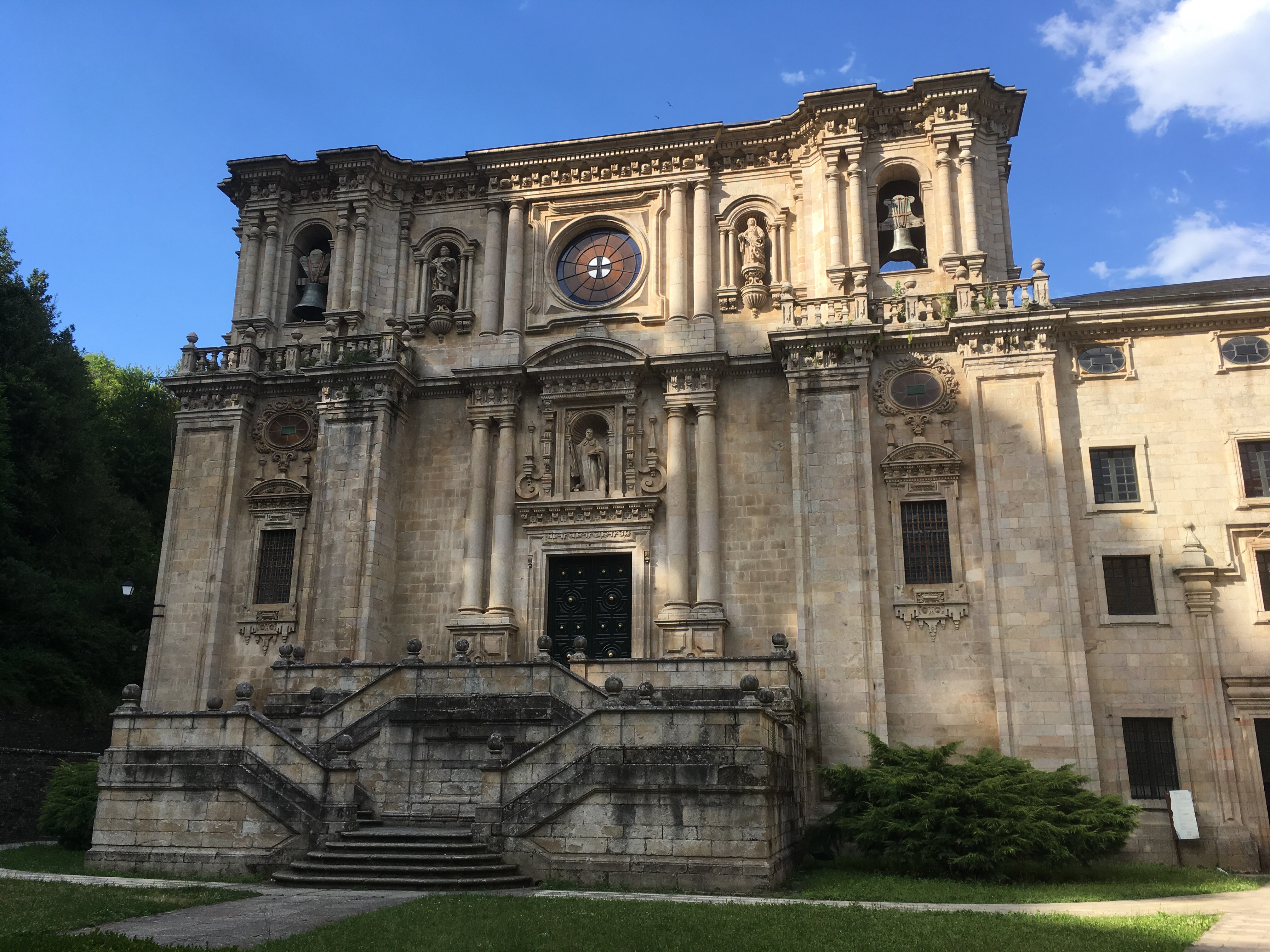
Well, by the time we reached the end of the main thoroughfare (if you  dared call it that) we were drenched in perspiration. So much for Underarmour heat gear! We had to make a choice, the high road (about 7 km shorter but with a considerable climb, or the low road which passed the Benedictine monastery in Samos, originally built  in the sixth century but recently rebuilt a few centuries ago following a devastating fire, but with the Camino following a dangerous highway). We chose distance (at least as the crow flies) over history. 

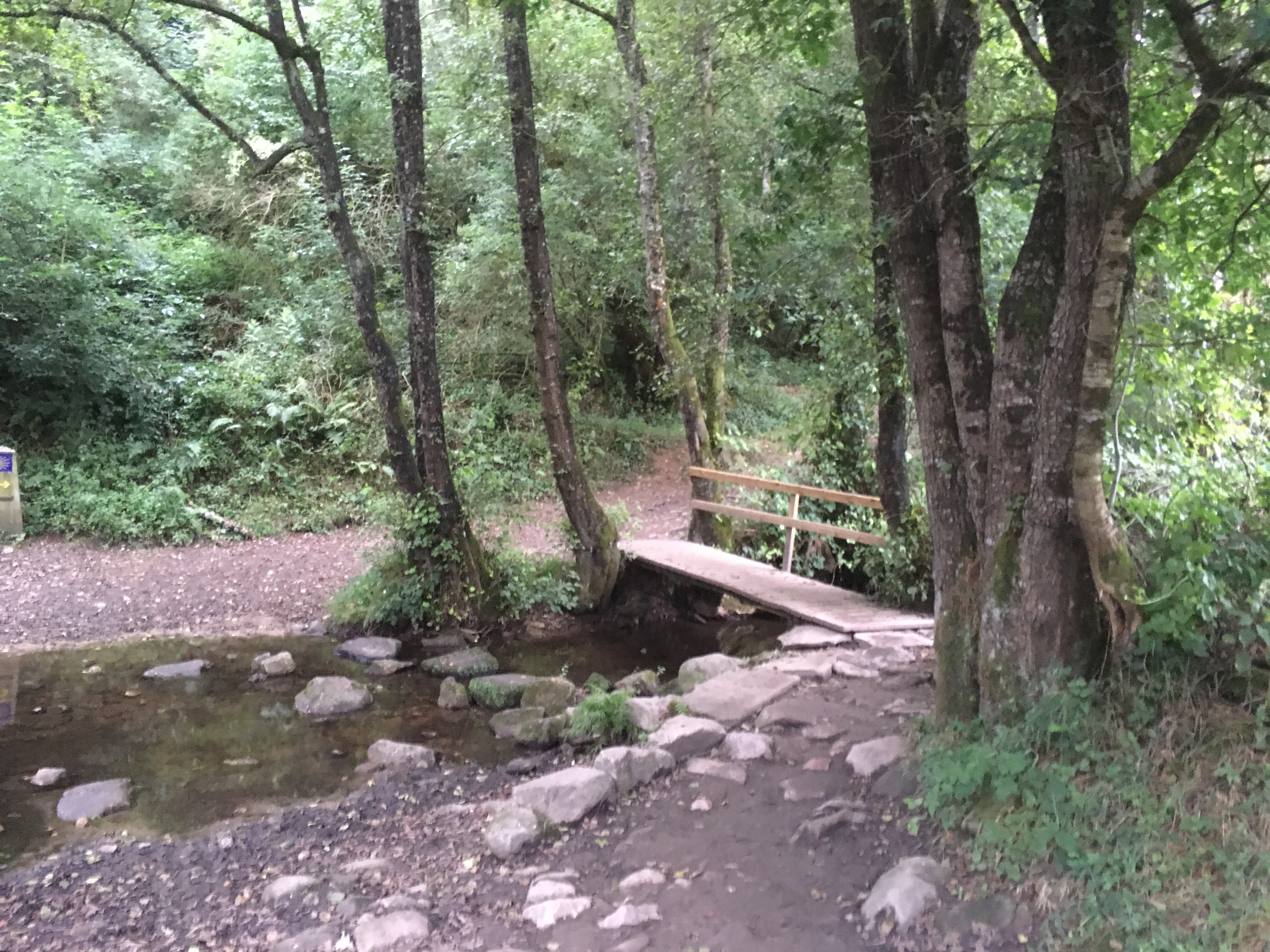
The heat of the day certainly manifested quickly as we made our ascent. We saw our first slug dragging itself across the Camino. In the first hamlet (too small for a village as it consisted of a farmhouse and barn-like complex, we were treated to a duet of dueling roosters. There are no places to stop for a coffee or a cerveza for over 7 miles, so we had to gird our loins and stay hydrated with mere water! After reaching a fountain with a scallop shell (painted garishly green and white- photo op!), we continued up the forested trail. We passed through San Xil, for which the Camino alternative is designated (Camino via San Xil). It consisted of a few small homes and a small cemetery. At this point we were on an asphalt paved road. A lot more pilgrims are on the Camino now as we approach Sarria, approximately 100 km from Santiago (you need to walk at least 100 km to receive the Compostela ( more on that later). Most of them missed the turnoff into the woods and continued on down the road. We took the Camino “shortcut” down steeply graded stoney pathway under the cover of trees. We crossed a narrow stone foot bridge over a small stream and then joined the wayward pilgrims who chose highway over nature. 

We finally saw our first bar – Casa do Franco – Franco was born in Galicia but I suspect it wasn’t in this house. We shared our bocadillos with the local farm dog, who by the way only will eat cheese and ham and bypassed the bread – must be on a low carb diet!

We trudged along the road paralleling farmland for several more km after one more stop for large cervezas for rehydration, reaching Sarria around 2:30 pm. It’s a decent sized city, around 16,000, and we are staying in a decently sized modern hotel with great wifi (Alfonso IX). After shower and rest time, we took a taxi for Samos. It was too late for a guided tour of the monastery but we did attend evening vespers (with Gregorian chants) and pilgrim’s mass. Our taxi driver returned us to the hotel around 8:30 pm and we strolled the river promenade, deciding on a dinner of pizza and caprese salad with a cerveza and two diet cokes for each of us.

Lesson of the day: Slow and steady (like a slug) and listen to your body (and keep hydrated.)