I’m a bit sleep- deprived due to a combination of sore legs ( we walked 10 miles yesterday) and thunderstorms throughout the night. The espresso after dinner last night didn’t help either. We had an early breakfast (I’m going to miss the treacherous spiral staircase to the breakfast room) and were packed and ready to leave the hotel at 8 a.m. Since we were in the Old Quarter with its narrow 12th century streets, this necessitated a 15 minute walk ( in a light rain) to our bus, rolling our suitcases over the wet and slippery cobblestones to the place where large busses can wait. The bus driver, Peter, is from Slovenia and he spent yesterday driving to Prague from his home in Ljublana. The bus is quite spacious as our group had 26 and there are 50 seats, and we can spread out over two seats. There are drinks available for 1 Euro – water, Coke, and beer (a Slovenian brand)!
Leaving Prague, we were stuck for a while in rush hour traffic. The main highway goes through the city, as there were so few cars in the Communist era when it was built and there was no need for a bypass highway. Katka told us one could leave Berlin and the road ends right in front of St.Wenceslas Square. The outskirts of the city are the headquarters of many international companies – such as Hewlett-Packard, KPMG, IBM. We are headed initially to Brno, the second largest city in the Czech Republic, before our lunch stop in Stramberk.
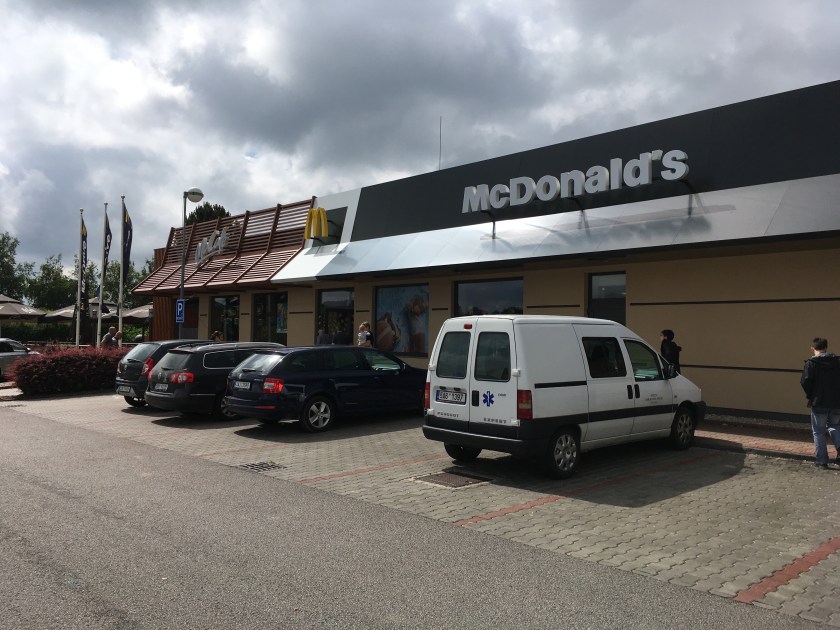
The very bumpy highway (lots of road reconstruction to improve Communist era built roads) passes through rolling green fields and stands of mixed evergreen and deciduous trees. Our first rest stop was at a McDonald’s, of all places. Bathrooms are free there, unlike at most rest stops or cafes where one needs a 10 Czech crown coin (about 50 cents). Most Czechs can’t afford to eat at McDs as a meal tends to cost about 200 Czech crowns (about $10) whereas a meal in a local restaurant offers meal specials for half the price! The McDonald café has fancy desserts displayed in glass cases in addition to espresso, lattes, and cappuccinos.
Katka gave us a taste of Communist era soft drink – Kofola – with a citrus and licorice essence and very little sugar, that was the substitute for Coca-Cola. She then spoke of life under Communist rule – the monotony of a State-dictated job, the fear that ones neighbor was a police informant, the inability to purchase Western goods, like Levi 501 jeans! She recounted tales of her father smuggling leather jacket from Poland, paying off the border agent with cigarettes.
For the lunch break, we stopped in the small village of Stramberk, in the Carpathian Mountains. It is a quaint spot with several small restaurants and two tiny hotels surrounding a small park.
 The local specialty is a type of gingerbread shaped into a cone called “usci” or ears – it refers to the ears cut off by the Mongols who terrorized this area over a thousand years ago. These “cones” are usually filled with fruit and cream. Since we are leaving the Czech Republic, any leftover Czech crowns would be of no use so we were encouraged to at least get rid of our coins.
 We had lunch in the local brewery- the owner gave us some of the homemade beer brandy as an aperitif. It tasted a bit like grappa. The usual stuff was on the menu – goulash, roasted pork, pork knuckle, bread dumplings. Tony had a garlic soup and sauerkraut with his roasted pork ribs. I had salad (iceberg lettuce, cherry tomatoes with mustard vinaigrette topped by a savory spiced and grilled chicken breast. We hiked up to the top of the town to see the tower and the amazing views. As our group reconnected Katka had us toast farewell to the Czech Republic with Slivovice, the traditional plum brandy. Back on the bus, Katka informed us about the region, part of the Sudetenland (“land of the wild boars”) – the Nazis evicted the Czechs from their homes in the lands bordering Germany and Austria under the pretense that the Czechs were mistreating the Germans living there. Rather they desired the rich natural resources, coal and steel mills to strengthen their military prowess. In the little hamlet we just visited, 70% of the inhabitants had two weeks to evacuate, most moving to Prague with the meager possessions they could transport with them. After the war, the Germans were evicted and sent back to East Germany.
We passed into Poland, the birthplace of my father, without a notice – no more border checks. The only difference I can see are road signs in Polish and the red and white roadside markers. The skies have cleared and we are seeing the first sunshine of the day.
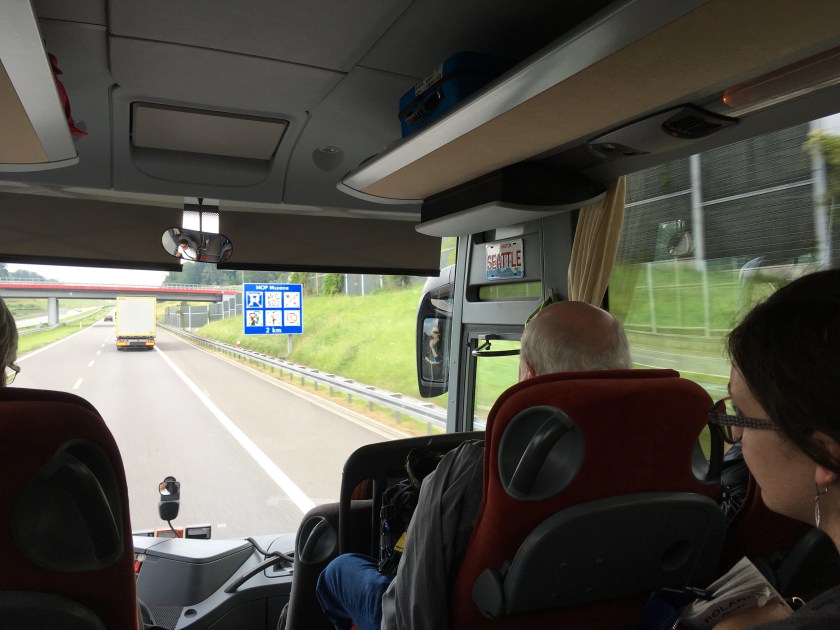
We had a rest stop at a KFC of all places! They are everywhere in Prague and apparently in Poland, too. The chicken tastes much better than in the USA according to one of our group.
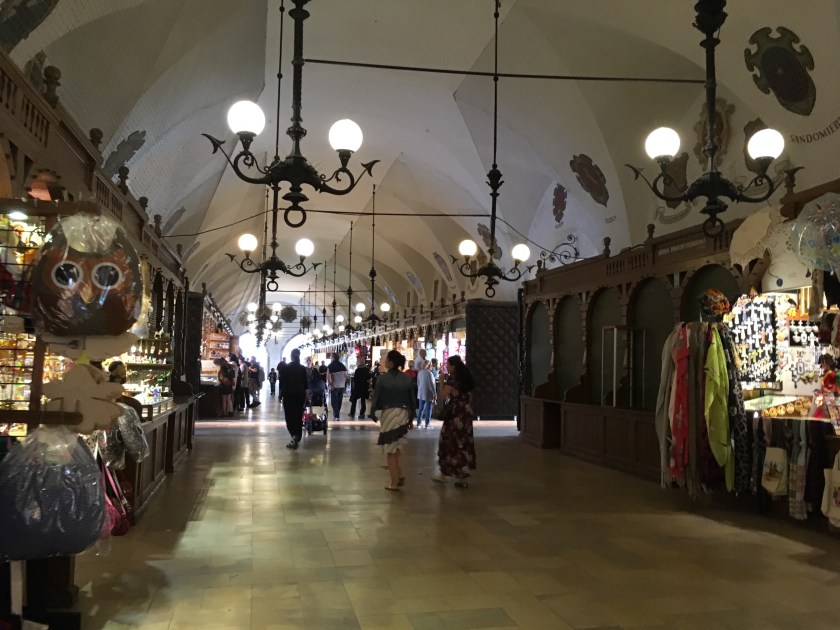
We arrived in Kraków around 6:45 pm. The Hotel Francuski is at the edge of the old town. It is a grand old style building, but it only has “natural” AC, i.e. open the windows! The old cloth market at the center of the square is now a collection of vendors selling handicrafts.
 St.Mary’s Church is known for being the parish of Karol Wotyla (otherwise known as John Paul II) and every hour on the hour a trumpeter plays a song out of the four sides of one of the towers.
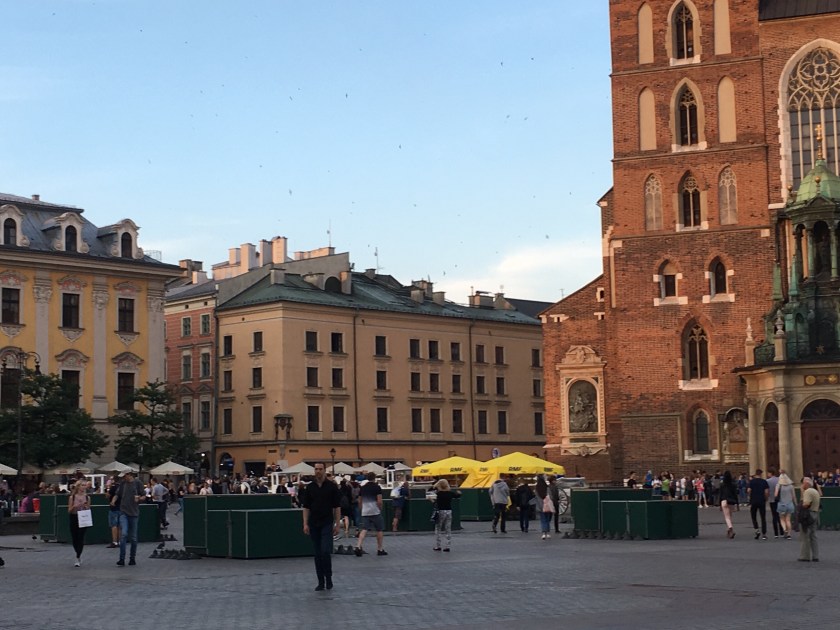 The Square is lined by cafes and is bustling with strolling tourists and buskers.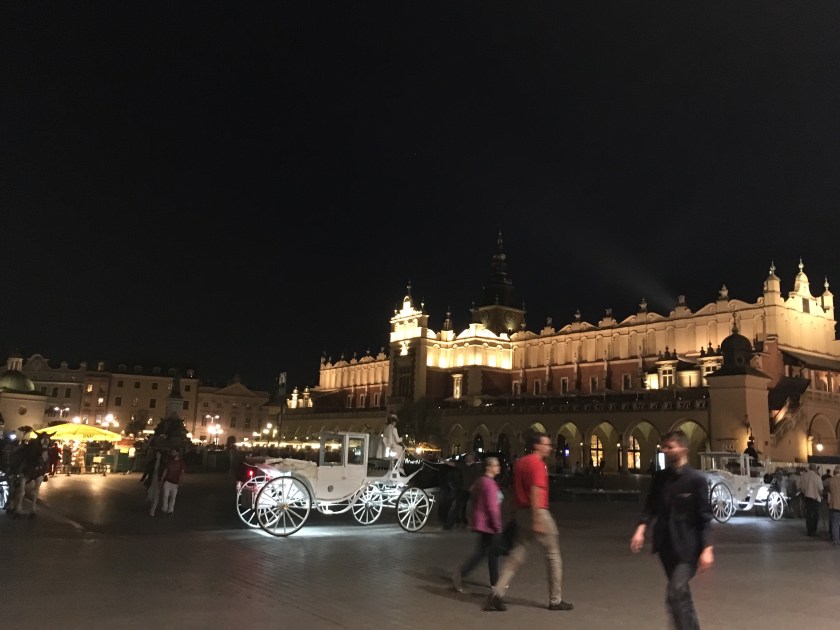
We enjoyed a traditional Polish meal- potato leek soup, pierogies, trout, cheesecake, along with a taste of cherry vodka at a restaurant on the Square- Wesele- a popular place for wedding celebrations. A wonderful end to a long day!

 Camino Musings